Showing posts with label House Rules. Show all posts

Sunday, March 19, 2023

SCL

THREE RULES FOR OSR GAMES

Just a quick set of house rules that sound fun and useful for OSR games. The idea is you can keep the rules as written as much as you like, but just add these as a final layer on top for players to use. These are all situation-driven, so there's no record keeping.

Let's call this set of three the SCL (Solid Crit Luck), for shorthand. Or maybe A-SEAL because it sounds like that when you say it. Doesn't matter.

1. Solid Hits.

This comes from GOZR. If you succeed on an attack by 5 or more, you get Adv on damage roll.

Fighters can choose to divide their damage between up to 3 adjacent targets, even though they only technically hit one of them. Example would be hitting a goblin and getting 10 damage. You could give 3, 3, and 4 damage to three of the gobbos.

If it is a saving throw, and if making the save still deals some kind of damage to you, then a Solid Hit on the save halves the already reduced damage.

If it is any other roll and you succeed by 5+ or by 25% or more, the GM may grant a small boon in some cases. Maybe just name a trivial benefit (see item 3 below).

2. Double Crit.

If you crit and then roll max damage, you have a double crit. Whatever effects your crit normally has, you double them. Obvious example is damage x2 then x2 again. But if you get a benefit, such as an extra attack on a crit, then you get another extra attack.

This one assumes you use crits, of course. If you don't... I cannot help you.

3. Lucky Number.

Roll 1d20. Whatever the result, this is your character’s lucky number. Any time you roll this number on any attack roll or save, you get to name a trivial benefit. The GM can veto or tweak it, of course.

Example: Your number is 11. You roll 11 on an attack. Not enough to hit! But you say “My attack throws him off balance.” The GM agrees and either grants you +1 to the next roll or penalizes the enemy by -1 on their next attack.

This one was inspired by Neoclassical Geek Revival, which I haven't played. So I don't know how it works in that game, I just know it has a similar rule.

Monday, May 30, 2022

The Paint Job

No, this post is not about painting or art. It's about old school gaming, house rules, and hacks. It's a bit meandering. Apologies.

I've been thinking about the many, many ways I've hacked B/X to make it play closer to my ideal way. This is no more evident than in all the different posts I've made about fixing the broken Thief class.

I've been working on various ways to alter the standard rules for my upcoming Doomslakers B/X project. I have wrestled with lots of ideas and found them all too fiddly, too trivial, or just too much.

Lately I've hit upon an idea that seems promising, though. It's a simple one, nothing rocket-science about it.

Instead of hacking the rules, maybe I'll just present my "meta rules" as an option, then keep the rest of the content more-or-less defaulting to the standard rules. For my own games, I use the meta rules, But you don't have to.

Most obvious example is luck. I always include some kind of luck mechanic in my games because I feel like without some degree of direct player-facing mechanic other than mechanics tied explicitly to character action, players often feel frustrated by game play. I know I do, and this is why I include such mechanics.

But luck doesn't modify existing rules, it just goes on top of them like a nice paint job.

What other kinds of rules could function in this way?

Well, Death or Debasement is definitely going to be part of the project. This comes from GOZR. It basically says when your PC dies, you get to decide if they are actually dead or not. I mean, why not? It's your character, after all.

Choosing Debasement means your PC is miraculously alive, has 1 hit point, and will be down for 1d6 rounds (probably out of the fight). Alternatively, perhaps they need to pass a Death save to recover and act.

Choosing Death means they are dead and you get some minor perk for your next PC, such as a bonus to an ability score or something.

Meaningful choices. More interesting that flat out death at zero hp.

EDIT: Choosing Debasement also means you randomly roll (or maybe choose) one permanent effect, such as losing some HP, dropping in an ability score, or something more in-world, such as losing a hand or whatever. Surviving death isn't free.

Another meta rule concept isn't so much a meta rule as a setting rule. Not unlike the old AD&D 2e "kits", the setting itself will modify character classes and PCs with choices the player can make, such as rolling on random character traits tables.

Here's where the Thief gets a lot of love, too. Because in Yria, the world of Doomslakers and Black Pudding, all Thieves are trained by a guild and there are five guilds, one for each city. And each guild's training impacts a Thief's skills and abilities in specific ways. The player who chooses Darkmirth as their guild (and perhaps home city) will be much better at stealth while the Thief of Kanebok may be more acrobatic and better at stunts. For example.

The net result of all this is that to play games set in Yria or to just mine Yria for ideas and adventures you don't have to adopt any of the meta rules if you don't wanna. It's fine. My feelings will be hurt but that's ok.

I'll ramble more later.

Thursday, February 10, 2022

Yeah But Thief Skills...


My current thinking for Doomslakers B/X Thieves is to keep to the original class but grant substantial perks based on Guild affiliation.

But I may also include an optional rule that I also quite like (and probably would use more, if I'm being honest).

Ability Check Thief Skills

All Thief skills are based on Ability checks. Each skill is linked to a particular Ability score. Dexterity is very important, but other Abilities also come into play. If two Abilities are listed, then the Thief must pass a check on both in order to be successful. If a choice is given, the player chooses which Ability to use (this decision is permanent).


Open Locks (Dex, Wis)

Remove Traps (Dex, Wis)

Pick Pockets (Dex, [Wis])*

Move Silently (Dex)

Climb Sheer Surfaces (Dex or Str)

Hide in Shadows (Dex)

Hear Noise (Wis)

Disguise (Cha, [Wis])*

Evade (Dex)

Forgery (Int)

Read Lang (Int)

Use Scrolls (Int)

Poison (Int, Con)

Mimicry (Cha)

*If the target’s level is higher than the Thief’s level, the Thief must also pass a Wisdom check to be successful.

The Thief gains +1 to one skill category per level, applicable to the Ability score for purposes of the Ability check (or just subtract it from the die roll). The Thief’s Guild also modifies Skills in particular ways.

Saturday, January 15, 2022

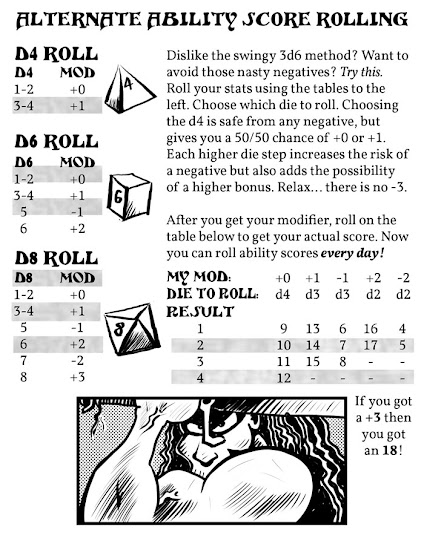
Alternate Ability Rolling Method


Here's something for Black Pudding 7. I haven't used this in play, but of course I played around with it myself and kinda dig it. Maybe it's not new, I'm not sure. I hadn't seen it.

This method does not get you a nice bell curve. For example, it's far easier to get an 18 since it is a 1 in 8 chance. If I was "gaming the system" with this, I'd just always roll that d8. Which, of course, is totally valid. It's your choice. You aren't breaking anything

Just rolling the d4 all the way gives you an average PC that has no negative and three +1 stats... which is pretty nice too.

EDIT: I posted this in haste from an old thing I forgot about and it has shitty formatting so you should ignore it. I didn't proofread bc nobody got time for that.

Friday, January 14, 2022

Doomslakers Elf

For the Doomslakers B/X book, my Elf class tweaks are kind of like this.

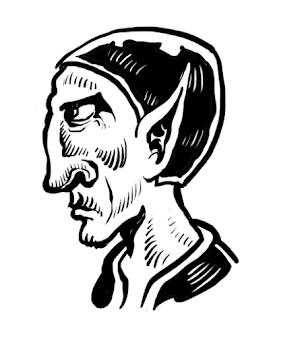
1. Lawful Elves are the keepers of tradition and knowledge, very concerned with preservation of history and continuity of the world. They are very tall, often lean. Like creepy long and alien in some ways. Maybe called "high elves".

2. Chaotic Elfs (not spelled "elves") are absolutely not concerned with that shit. They are very short and have a preference for the physical pleasures. Maybe called "low elfs".

3. Neutral Elves don't have a dog in the fight and tend to be slightly shorter than humans.

Lawfuls and Chaotics also have minor tweaks to ability scores but otherwise the class is unchanged.

This is in contrast to the Magic-User, which is significantly changed. Current plan is to replace it with the Wizard class but honestly that's just semantics. We'll see.


Friday, December 24, 2021

I Fight!


The Fighter.

I haven't posted as much about this class as others, mostly because they are pretty cool as is. I did post some simple house rules here though.

Of all the basic classes, the Fighter is perhaps the most meat-and-potatoes. The B/X Fighter's benefits are basically this:

1. Best attack values, along with Dwarfs and Halflings of course*

2. No weapon or armor restrictions

3. Can use the fuck out of magic swords

4. Best hit die, along with Dwarfs of course

For Doomslakers B/X I have really struggled to articulate this class. Because there are two competing things going on. First, you can add tons and tons of house rules to make Fighters much cooler. But the aesthetic of B/X leans toward simplicity and I'm trying to embrace that way. So I do not want a ton of fiddly bits. I want Fighters to be as unchanged from the original game as possible. They need to be simple.

That being said, here's my fairly simple additions to the B/X Fighter class for Doomslakers B/X.

Weapon Bonus

Fighters are particularly good with a single type of weapon, gaining +1 to hit and to damage when using weapons of that type. Choose between: axes, bows, daggers, swords, or other.

At every fourth level (4, 8, 12) the Fighter gains the same bonus in a different category.

Crits & Momentum

Upon scoring a Critical Hit, a Fighter can immediately attack again if there is a target within range. Also, when a Fighter slays a target they can immediately attack another target that is within range due to their killing momentum.

Battle Moves

A Fighter can declare a stunt or special battle move before making an attack roll. If the attack hits, no damage is dealt but the maneuver succeeds. For example, a Fighter can disarm their opponent, kick a brick loose to topple some stones, or some other equally cool stunt. The GM will consider the difficulty and utility of the stunt and apply an attack roll penalty as they see fit.

If a Battle Move causes a ruckus that could cause damage to foes, the GM may grant Saving Throws vs. Paralysis for the affected enemies. The damage dealt should be modest (generally 1d6). For example, knocking over a large statue into a throng of charging guards might deliver 1d6 points of damage to any guard failing to make the Save.

(Battle Moves were presented in Black Pudding #4. Clearly this is inspired by DCC RPG's Mighty Deeds mechanic, but also it flows naturally from game mechanics such as Feats, which are quite common. The genius of Mighty Deeds is to disentangle the idea of a Feat from it's spell-like clarity into a more creative outlet.)

*Though it does SUCK MUCH that all PCs attack with the same values for 3 levels. It would have made more sense and been more elegant if Fighters started with a slight advantage in this area. For a one shot game, this means playing a fighter is not the best pick, even if you wanna fight. Better to choose Elf. Sure, the hit points are SLIGHTLY less but you have the exact same fighting prowess otherwise AND you get a magic spell. But I digress...

Tuesday, December 14, 2021

Thief: +25%


After posting this Thief thread recently I had another couple of little thoughts of only miniature merit.

My Double Dexterity house rule puts a huge premium on the Dex score. For my own games, this is fine because I let players put their scores wherever the hell they want. If you're gonna play a Thief, you'll almost certainly put your best score in Dex. And I think that's perfect for my campaigns.

But what if you run games a little bit more close to rules-as-written? Meaning, what if you do the whole 3d6-in-order thing? Then it is probably going to be the case that only players who happen to roll a good Dexterity will choose to be Thieves. In that case, perhaps an even simpler house rule would suffice: Thieves add +25% to all skills other than Climb Sheer Surfaces and Hear Noise.

I mean, this isn't a genius move or anything. It's a blunt instrument. The Thief skills are too low, we all agree*, and this is just a brute way of addressing that fact.

Another idea for the 3d6-in-order crowd (or anyone, I suppose) is to give Thieves a randomized bump. The player rolls dice for each skill at the point of character creation and adds the result to the skill. This one just hit me, actually. And I kinda like it, in principle, because it makes all Thieves very unique in their skill sets. So let's explore this by looking at some ways to randomize it.

1d100: Just roll 1d100 and add the result as your bonus. Uber swingy! You might start with Hide in Shadows 21% and Pick Pockets 105%. But what an excellent reflection of individual thievery.

1d20: Far more modest, low key. Blah.

3d20: Now this is interesting. You'll have an average bump of 30 points, which puts your skills around the 40%-50% range that the Double Dexterity rule gives you. But it disentangles skills from your Ability score, if you like that sort of thing.

3d6 Exploding: Hmm... average of 10 or 11? With the exploding bit I'm not sure how to do that math. I suppose the average would be higher than 11 but not by too much. Yet you have the potential for a huge skill bump if you luck out and roll a lot of 6s.

Off the cuff... out of all these ideas I actually like the +1d100 one the best. It's super swingy but that really adds some flavor to your PC right out of the gate. Like why is Sniffle the Sneak total shit at picking pockets but he can melt into the shadows like a magic ninja? Perhaps he gets nervous around people.

Ideas and shit.

*We all agree.

Sunday, December 12, 2021

Doomslakers Project

I've been posting quite a bit about doing a B/X style 64 page book, ala the B/X 64 Challenge. This is part of a continuum of ideas dating back years on this blog. An early example of this project in action was Black Pudding #4 with the OSR Playbook. I was calling it the Yria OSR Reference here.

More recently, The Rock Hardy Book of Dwarfs idea has been on my plate and it is that concept that morphed into the current Doomslakers B/X Playbook. This is how my brain works. One idea evolves until it is a different idea and eventually the cascading ideas coalesce into a book. I've just been a bit slower at it of late. Ideally I like to finish a few books a year but if I can make 1 book happen I'm happy about it. At least I'm not dead yet.


Right now I have a small barrage of commissions I've agreed to do so I don't know when the Doomslakers book will be finished. But progress is happening. I have written some satisfying bits about the 7 core classes that form the backdrop of the adventuring scene in the world of Yria. They are, currently, and in order of frequency among the adventuring population: Fighter, Thief, Dwarf, Goblin, Elf, Wizard, and Botten.

All classes get some kind of tweak from their B/X roots. Dwarf might be the least altered. Goblins are very similar to the version of the class that appears in Black Pudding #4 but with a few tweaks. Botten are machine people who I have written about before and used in a few games.

I'll write more about the classes later. In the meantime, why not do your own B/X 64 Challenge? Create and publish a B/X based book within 6 months. Hashtag it #bx64 and share the process online. It doesn't have to be 64 pages.

Sunday, December 5, 2021

Thief Me Baby One More Time

Given how many times I've written about how to fix the B/X Thief you'd think it was my favorite class. Not true. If I'm sitting down to play B/X at a con or whatever, I'm probably picking Elf. POWER GAMER.

Anyway... thieves.

This is a shit or get off the pot kind of moment. I've noodled Thief fixes for years but since I'm cementing my B/X house rules in a printed book forever I need to pick a path, right?*

TL:DR: Thieves add double Dexterity to most of their skill ratings and they get 7 new skills.

The current draft includes these fairly simple tweaks:


1. DOUBLE DEXTERITY ADDED TO SKILLS

Thieves add double their Dexterity score to all Skills except Climb Sheer Surfaces and Hear Noises. When trying to Find Traps, they add Intelligence x2 instead of Dexterity x2.

Let's talk about it.

First of all, the exclusions. I exclude Climb Sheer Surfaces because those skill ratings are already quite good. I suspect the designers didn't want to subject the lowly Thief to dying from a fall multiple times per session. Because while it's logical to say that failing to Move Silently does not mean you were heard it is harder to logically argue that failing to Climb means you didn't fall. I think I get it. Anyway, you don't add double Dex to that skill.

You don't add it to Hear Noises because that's the only Thief skill that isn't a god damn percentage.** 

Second of all, the skill ratings are famously and monumentally shitty. We all know it. Some of us like to make rational arguments to justify low scores but in the end we're just wrong and grasping at straws so we can idolize the most perfect TTRPG ever published. The Thief skill ratings are just too damn low. It would have been far better to start them around 50% and just slowly raise them by 2 or 3 each level or something like that. But nooooo. Fucking 10%.

Sorry, ranty moment.

Doubling your Dex and adding to the skill ratings brings your chances up towards 50% to start. For example, you have a 20% chance to Move Silently at level 1. Let's say you roll up a Dex of 14. Your Move Silently would be 20+14+14=48%. Not bad. It's on par with the chances of a first level PC hitting a target with AC 9 [10]. It makes some fucking sense, if you ask me.

"But James, this places a lot of weight on the Thief's Dexterity score. The original game didn't emphasize stats this much. Are you sure about this? What if the player rolls a really shitty Dex score?"

Yes, I'm sure. B/X gives us the well-loved roll-under-Ability mechanic, after all. Clearly the game was realizing that Ability scores aren't just window dressing and a bonus to XP isn't as super sexy as they thought it was. Also, I made 4d6-drop-lowest and place-score-where-you-want canon in my games. It's statistically unlikely that the Thief player will not have a good Dexterity score. As it should be.

"But James, then the 9th level Thief has a 103% chance to Move Silently! That seems very high to me."

Yes, 103% is very high. But consider these points. First of all, and let's be honest here, the lion's share of B/X play happens in the 1-7 level range. If you're running con games, you're doing level 1 or level 3 or something like that. If you do a campaign, it'll likely peter out by name level. But OK... let's say it doesn't. So second of all, who cares? The 9th level Thief is a Master Thief according to the level titles. Let them be mutherfuckin' masters. The DM can always make the situations harder and apply penalties. That's kinda how this game works. And it's especially ok when you're not playing with 36 levels.

"So, James, if these pathetically low Thief skills irritate you so much why not just house rule an entirely different skill system?"

Because when it all comes down, this is a B/X fan production. If I wanted to make a whole new dungeon game I'd do that instead. But I'm making a B/X inspired RPG supplement. I wanna preserve as much of the original spirit as I can. I want as few changes as possible. Simple as that, see?


2. ADDED SKILLS

When I went to Gary Con I met Frank Mentzer. This was like meeting a rock star for me since it was his red box that was the first RPG that I ever owned. I used it so much that eventually the box fell apart completely, long lost to time and the trash bin. So I asked Frank one question that always bugged me. In B/X's Expert book under the Thieves section for higher level play it says that in the fabled Companion rules the Thief would gain skills such as ventriloquism, distraction, and climbing upside down. I asked Mr. Mentzer why he didn't include those in the official Companion rules.

He said they were silly so he didn't want them in there.

Major points lost, Frank. Major points lost. My man... climbing upside down, scurrying across a ceiling like a fucking demon ninja? Hell yes.

So I added these skills to Thieves in the world of Yria, where Thieves are somewhat like assassins in that they have secret signs, secret guilds, and highly specialized training. I didn't add these to any Thief XP table because, again, I wanted to preserve the original spirit. So each of these skills simply uses the ratings of existing skills (in parenthesis).

-Evasion (Remove Traps)

-Climb Upside Down (Move Silently)

-Ventriloquism (Hear Noise)

-Mimic Voice (Hear Noise)

-Disguise (Pick Pockets, adding Intelligence x2 instead of Dex, and modified by the target's level in the same way as Pick Pockets)

-Forgery (Pick Pockets, adding Intelligence x2 instead of Dex, and modified by the target's level in the same way as Pick Pockets)

-Use Poison (Open Locks, adding Intelligence, not doubled, with serious risk)

Thieves are the original skill class, after all.

*Of course this is not true. The Doomslakers B/X Playbook is but one iteration of B/X campaign house rules and setting notes. Many more could follow! I can dream.

**WTF, designers? Did you not realize in 197x that in 202x people would be critiquing your work? Anyway, I'm kind of OK with the Hear Noises ratings. If anything I'd bump it up by 1 to start. So maybe that Wis modifier could play a role. But I'm thinking just leave it alone.

Saturday, November 20, 2021

BX Wizard Revised

I posted about this before. I've used a version of this class in play and I feel like this iteration is closer to what a B/X wizard should be. So for my B/X games I'll be using the Wizard to replace the ole Magic-User. Why?

More cool options for low level play - which is where most of my gaming takes place.

How is this different from the standard MU?

1. An extra spell at level 1.
2. More versatility in spell levels you can memorize.
3. Ability to use weapons and armor in a sensible way beyond "you can't use that".
4. Putting magical research and potion making front and center so the players will actually USE them.
5. Some immediate weirdness... a minor magical item, reaction roll penalty, etc.
6. Combining MU and Cleric spells because I honestly don't care about Clerics at all. I don't need them.

Note that this Wizard can only memorize a spell once at a time. So they cannot be a healbot with multiple Cure Light Wounds.

I'm open to arguments for why this iteration of the Wizard is broken. I might have a blind spot so I appreciate feedback. This will likely end up in whatever Yria setting book I end up publishing.

Some of this was inspired by Stuart Robertson's old B/X Witch class, which I really adore.

EDIT: A hero in comments pointed out some errors so I fixed 'em. Hopefully better now.


Thursday, August 26, 2021

You're a Wizard!


Old school Magic-Users have a tough row to hoe at low levels. The payoff is that when they gain higher levels nobody can fuck with them.

But here's a problem: Most players of D&D (especially classic editions) are playing low level characters almost all of the time. This is especially true for public games where the tendency is to run little dungeon romps for characters in the 1-5 level range.

Wizards in this range are fragile and can't do much. And anyone who argues that you can "still throw a dart" is a fool. Don't listen to them.

Make low level wizards better instead. It's the morally correct thing to do.

To that end, here are some ideas and thoughts I've had about old school MUs over the years on this blog.

In Read That Magic I kind of go off on a rant about using B/X rules as written and how it makes playing a first level wizard kind of lame. I still feel that way. If we assume most games are not going to get into higher levels, then you need to beef up them wizards. Don't be a tool.

In OSE and B/X Spellbooks I talk about three ways you can play B/X rules as written and work it into the fantasy fiction of your campaign. I like these ideas, though I'm prone to just house ruling the shit out of wizards instead.

In Magic-User with Sword I talk about allowing wizards to use weapons other than daggers and to wear armor. Because I detest the notion that they somehow just can't do it. Let your wizard pick up a sword, for crying out loud. They'll suck at using it.

NOTE: One thing I didn't address in that post was just how much emphasis B/X puts on magic swords and just how much benefit that is to the Fighter class. If the wizard can also use a vorpal sword or +3 sword or whatever, then the Fighter's niche is threatened. I get that. And I'm actually OK with the caveat that magic swords want to be used by warriors, not wizards. So a +3 blood drinking sword might simply refuse to function in the hands of a wizard. It's magic, after all.

In B/X Wizard I present a Wizard class for B/X. This was used in my Isles of Rone game and worked quite well, though we only played at level 3. It's actually a little bit more fiddly than I prefer in a B/X class, but perhaps not over the top. It includes the use of other weapons and armor, brewing potions, using both M-U and Cleric spells (I tend not to want Clerics in my games), allows and emphasizes magical research from level 1 forward, and grants the PC one special item.

If I revised this class today I'd do it a little bit differently. I'd open up the Wizard's ability to create magic stuff, including potions, but I'd tie such efforts to time and money more explicitly. It should be no big deal for a Wizard to brew a potion if given a few days to work on it. But of course you don't want the power gamer to convert the 30 days of downtime since the last adventure into 15 potions. But you also don't want overly persnickety potion brewing rules (I still love keeping B/X classes to a single sheet of paper, if I can).

Another idea I'm noodling is to only have 4 house rules for Wizards.

1. You can brew potions, make magic items, and conduct magical research from level 1.

2. You get 2 extra level 1 spell slots from level 1.

3. You can use any weapon but you can't have it ready and also cast a spell and it takes a round to get it out or put it up.

4. You can wear armor, but you have to make a save vs. Spells in order to cast and the armor's AC benefit is a penalty to your save.

Just some thoughts.

Friday, November 27, 2020

BX Wizard

In this post I presented a Wizard class for BX that I'm using in a current campaign. I tweaked it a little and added my own art in this updated version. It is compatible with BX but definitely has more bells and whistles. Still... it's all on one page, with art and an XP table. So it's not too crunchy. I like it. I think this would make the beginning spellcaster more interesting to play. And yes, this class does in fact replace Magic-Users and Clerics in my current BX game.


Thursday, November 26, 2020

Lesser Gods Session Zero

Art © Glen Michael Angus, R.I.P.
BX D&D STUFF

We had session zero of Lesser Gods of Rone Monday night. We spent most of it making characters, discussing the setting, and sort of figuring things out. We got into the adventure for about half an hour - long enough that all the PCs are now in the same boat. Literally. Except the Lake Thing swimming near it.

We do have a Wizard in the party, so here's that character class. It's essentially the BX Magic-User with a few tweaks. Unless we run into any serious issues, this class will replace the MU in all my D&D games.

What's different about the Wizard vs. the BX Magic-User?

-Penalty to reaction rolls. Because wizards are weird and nobody should trust them.

-Fewer weapon restrictions. Because it's silly to limit them to a dagger. Just silly.

-You can wear armor, but it makes casting hard. Because it's more interesting that way. Most PCs will avoid it because of the difficulty. But hey... maybe you want to put some on because you're out of spell slots and you need to make it through this risky pass.

-MU and Cleric spells. This is just because I am not using Clerics in this campaign. Cult leaders can be Wizards. Or a special class. I never liked the basic Cleric anyway. (I'm also disallowing the memorization of the same spell more than once. So even if you do have a Cure Light Wounds spell you only have one of them.)

-Potion brewing. With an adequate lab, of course.

-Magical research emphasized (X51 needs love). And no need to wait until level 9 to create magic items.

-You begin play with a cool item. Because it's more fun that way. Show up on day one with a hat that sings.

-Disregard for spell level slots. This is just a house rule that I prefer. You just add up all spell slots and that's how many spells per day you can cast. You can't cast any spell level higher than your class level. Done.

This class was an amalgam of how I tend to treat MUs anyway + some inspiration from Stuart Robertson's BX Witch - one of the most elegant BX classes I found in the OSR circles. I was gonna have Wizard and Witch but decided there's really no need for both when a Wizard class with enough wiggle room can serve nearly all  your wizarding needs.

If you dislike this kind of thing because it makes the fighter less interesting to play, you could just give the fighter some love. I love the barebones BX game as much as anyone, but all of us house rule it. Nobody runs it truly RAW.

So... The party includes a Wizard (Jayne X Praxis), Lake Thing, Medusa (modified Black Pudding version, Dyson Logos), Nightkind (a piece of the night that woke up), and a Mariner (Andy Solberg). I'll post up all the classes eventually.

The Wizard is searching for their lost dad and the Nightkind is accompanying them, perhaps to understand a weird dream power they seem to be manifesting. They got a ride from the Mariner and picked up the Medusa as her island sank into the drink (related to the campaign? hmmmm...). The Lake Thing approaches because someone has been poaching gators from his swamp island and maybe it's this weird bunch in the rowboat.

The session ended with the PCs approaching the island of Knobbybones where a huge harpoon ballista was pointed at their rowboat by some unknown entities.


Sunday, August 2, 2020

Thief! Stop, Thief!

Sorting old shit leads to finding little lost gems or little lost turds. Here's a lost gemlet I found. I might have posted this on G+. I can't remember.

This is an alternate thief skills method. I have never used it, but I can't imagine it would suck too bad. The big caveat is that I didn't consider classes or races that have great saves. So if you're playing a game where race and class are separate, the smart player will always go for a halfling or dwarf thief to take advantage of this method.

Of course I was thinking of B/X when I wrote this... like I usually am. So with that system, I believe this would work quite nicely.

It looks like I wrote this in June of 2017.

THIEVERY BY SAVING THROW

Why not use saving throws to handle Thief skills? It’s a d20 roll, it has a built-in target number, and it scales by level.

There are seven Thief skills. Five of them have percentile ratings that are roughly on the same level, starting as low as 10%. One of them, Climb Sheer Surfaces, has a much higher percentile rating. The last one, Hear Noises, uses a d6. To use the five categories of saving throws for Thief skills we’re going to condense these seven skills into five skills as follows. Yes, we’re basically ignoring the differences in some of these skills in order to have a clean system. I don’t think we’re losing much, to be honest.

Open Locks and Remove Traps
Move Silently and Hide in Shadows
Pick Pockets
Climb Sheer Surfaces
Hear Noise

Now, for my taste, I actually prefer something like the following, which adds some more range to the Thief’s skill set. But your tastes may vary.

Breaking and Entering (Open Locks/Remove Traps)
Stealth (Move Silently/Hide in Shadows/Pick Pockets)
Climbing (Climb Sheer Surfaces)
Awareness (Hear Noise)
Deception 

On the character sheet next to the five saving throw categories leave some blank lines. Have the player write in the names of her Thief skills next to the categories she wants to link them to. When a skill is used, make the save. Add the ability score modifier that makes the most sense for the skill.

A Thief’s best save is Paralysis, so the player would put the skill she likes best in that category. It is followed, roughly, by Death Ray/Poison, Magic Wands, Spells, and finally Dragon Breath.

Using this method the worst skill begins at 20% and the best skill is 35%. But the character’s ability score bonus, if they have one, can push that up 5 to 15 percent...much better than 10% starting out. Sure, the climbing skill is seriously nerfed but I’m not so sure that’s a bad thing. And if you want to preserve it or Hear Noises as they are they simply leave them as they are.

What I like about this idea is it uses an existing system that scales by level, it isn’t too far off track from the original skill levels (but still better), it utilizes the PC’s ability score modifiers, and finally it grants the player the freedom to focus on certain skills over others.

Friday, February 21, 2020

A Very Simple Thief House Rule

Thieves. The nasty buggers and their nasty nasty shitty skills in old school D&D. I ranted about this before. But here's a quick fix I actually used in my first ever Labyrinth Lordb campaign in 2014 or so.

Use the percentile skills as given but let the player add the entire score for the relevant ability to each skill. So for example you begin with a Move Silently skill of a paltry 20%. But using this house rule you can add Dexterity to that number. So if your Dex is 15, you're rolling 35% at first level. Still not fantastic, but much better than by the book.

Thief char sheet I drew for Blueholme.
I suggest pairing up the skills like this:

Open Locks - Dex
Remove Traps - Dex or Int
Pick Pockets - Dex
Move Silently - Dex
Climb Sheer Surfaces - Dex or Str
Hide in Shadows - Dex
Hear Noises - add Wis modifier

I also strongly suggest taking Cook/Marsh up on adding these skills to the Thief right from level one. Mentzer didn't include them because he thought they were stupid. Mentzer was wrong. I wanted my ventriloquism.

Climb Ceilings and Overhangs - Dex (as Climb Sheer Surfaces minus 20)
Ventriloquism - Int or Cha (as Move Silently +10)
Distract - Cha (as Move Silently)
Mimicry - Int or Cha (as Climb Sheer Surfaces)

Ventriloquism would work more-or-less like the spell. Distract would cause an enemy to lose initiative or get a -1 on their next attack. Mimicry would fool someone into thinking they were hearing another person or animal.

This is not the first time I've had thoughts about Thieves. Nor will it be the last. As long as the record stands that old school D&D Thieves suck there will be rants about it, not just from me but from everyone every day all the time.

Here I am talking about it in 2015.

And in 2016.

And I revisit the topic in 2019.

Thursday, February 20, 2020

Prowess AC

From the pages of Black Pudding #6, here is a house rule about armor class.

Prowess AC is an idea that I think would serve any sword and sorcery campaign well. If you're doing a high magic game, probably not so much. I'd also strongly encourage allowing PCs to improve their ability scores over time and/or having a more generous stat generation method than 3d6.

For those who might complain that this is unrealistic because of real world combat, all I can say is keep doing you and I'll keep doing me. Peace out.

But seriously, feedback is always appreciated on these little house rules as I don't always have the opportunity to test them out.


Sunday, February 16, 2020

Black Pudding #6 is Alive!

I just dropped the new issue of Black Pudding on an unsuspecting population.

It's free to download if you want. Drop me a few bucks if you can and if you dig the work.

I will post about the print version at a later time.

What is that sme...OH CRAP!
ASIDE: I know it's Zine Quest month. And that's weird because I didn't time this for that reason at all. Everyone who knows me knows I named my imprint "random order" because that's kind of how I create things. Randomly.

Saturday, February 15, 2020

Respite

I'm closing on a completed issue #6 of Black Pudding. One of the pages is devoted to a handful of little house rules that are unrefined and mostly untested. I'm calling it "unfinished puddin'".

Saturday, October 26, 2019

Black Pudding Heavy Helping Vol. One... Still Alive!

Never hurts to promote your work now and then...

Black Pudding Heavy Helping Vol. One is a re-organized, slightly re-mixed hardcover collection of the first four issues of my OSR-style RPG gaming zine Black Pudding. It's heavy on style and cartoony fantasy art with plenty of game-ready stuff like character classes, monsters, spellbooks, and ready-to-roll dungeons!

Luchadors!
Catgirls!
Hoard Horrors!
Whispering Vaults!
Sinewy Barbarians!
A Goblin!

With some nice contributions here-and-there from people such as Matt Hildebrand, Karl Stjernberg, Jayne Praxis, and Ed Heil!

The hardback book is a mere pittance at $18 and if you're cheap or you don't do paper then you can get a PDF for a trifle $6. You cannot fail in this adventure. But if you do, there's a random table to find out what the monster does with your ruined corpse.

Get yours while supplies last!

Front cover

Back cover

Saturday, May 25, 2019

OSR Weapon Damage


The topic of weapon damage comes up from time-to-time in OSR discussions. I think this is because we want that beefy fighter to be so very deadly with big-ass swords and we want that wee dagger to be more lethal than it is.

A lot of folks are in favor of straight 1d6 damage per weapon, as it was in OD&D. I hate that idea, but I get it. It means that the dagger is a better choice than it normally is and it allows players to be creative with their weapon choices since there's no mechanical penalty for those choices. But it also means - since all things really are even - weapon choice is virtually meaningless in terms of mechanics. Your skull-tipped mace and my super sharp scimitar both act identically in combat. I dislike this immensely.

Caveat: (Important caveat, no less) A good DM and player rapport will cause the nature of a PC's weapon to enhance play. My choice of a scimitar vs. your skull mace may mean that the Arabic-inspired setting has more respect/acceptance of my PC vs. yours. Perhaps your wicked weapon invites trouble everywhere you go while I can pass through markets and tea houses without excess trouble. Or let's say you choose a straight arming sword while I choose a staff tipped with 3 chains securing large iron hooks. A good DM would allow me to hook-and-pull targets on a good hit roll, but may also hit me with penalties when fighting in tight spaces. Meanwhile, your simple sword presents no particular advantages or penalties.

So yeah. Straight 1d6 can work as long as the group really embraces the narrative elements of weapon choice. I still don't love it, but I'm open to it.

Another idea is damage by class. My ideas below are in this vein, but I'm not a huge fan of the versions of this idea I have seen before because they never seem to leave the existing variable damage as-is for the "middle classes" such as Thief and Cleric. Versions I can remember seeing will apply something like a small-medium-large weapon category scheme and a die step for each based on class. I think this is perfectly logical but also kind of bland. To me, it robs weapons of their character.

Some people even go as far as limiting the Strength modifier in combat to only fighter types. I get that too, but I hate it.

I'm a B/X guy through-and-through because of the versatility of basic rules such as variable weapon damage (an optional rule but let's be honest... almost everyone uses it) and the universal ability modifiers. It means I can play a B/X Magic-User who has an 18 Strength and I can be potentially a better fighter than the party's actual Fighter - at least at very low levels. This bugs a lot of people because of class niches and what-not. I get that too. But I don't care. It lends greater diversity to characters in a game with precious few built-in bells-and-whistles.

Think of that B/X Thief who got lucky with a high Str, Dex, and Con. Give that guy a two-handed sword and you got yourself a bona fide sword-and-sorcery hero.

So yeah. Ideas. There are others too.

Here's a couple of ideas I had that I might drop into my next B/X game (maybe not both). These might have already been dreamed up by some other game nerd so please post a link if you have seen either of them before. That would be awesome. I certainly have not read all the reams of blog posts out there in the OSR-o-sphere.

IDEA #1: DIE-STEP WEAPON DAMAGE

Your character's class determines the die step used for weapon damage.

CLASS DIE STEP
Cleric Normal
Dwarf 1 die step higher
Elf Normal
Fighter 1 die step higher
Halfling Normal
Magic-User 1 die step lower (min. 1d4)
Thief Normal

For general use, not necessarily specific to B/X, it would be like this:

Wizard types = 1 die step lower
Rogue/Cleric types = no adjustment
Fighter types = 1 die step higher

Race would probably be irrelevant since race in 1e or Advanced style games confers somewhat less advantage/disadvantage (or should) than in B/X where the class and race are the same.

IDEA #2: DAMAGE SCALES BY CLASS AND LEVEL

Some classes get damage bonuses as they level up.

CLASS DMG MOD
Cleric +1 per 2 levels
Dwarf +1 per level
Elf +1 per 2 levels
Fighter +1 per level
Halfling +1 per 2 levels
Magic-User +1 per 5 levels
Thief +1 per 2 levels

So Idea #1 I really dig because it doesn't mess with the existing damage values for weapons nor does it require new categories to be graphed on. You just have to go a die step up or down depending on class. It makes the dagger more serious for warriors and the sword less effective for wizards.

(I do allow wizards to use any weapon because it's fantasy. The downside is their to hit rolls suck and maybe I make them spend a round drawing or sheathing because of lack of expertise.)

Idea #2 seems like it would also go a long way toward addressing a big problem. Why is it that my level 1 fighter deals exactly the same damage as my level 9 fighter with the same weapon? It just doesn't FEEL right. It's heroic fantasy... I want to FEEL like I'm just god damn better at this shit than I used to be. So a fat +9 to damage with that dagger I picked up on the battlefield would do the trick. I dunno... I'm sure there are downsides but not sure the downsides outweigh the asskickery.