Showing posts with label AD&D. Show all posts

Saturday, November 26, 2022

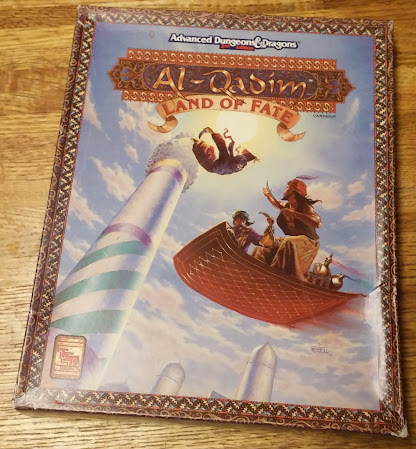
Land of Fate Cover Art

I'm curious how this cover to Al-Qadim's Land of Fate box set came to be published. Fred Fields is an accomplished, talented artist. And this cover art is not BAD. 

But consider it for a moment. There is a lot of dead space here. Lots of blue sky, the bottom of a rug, and just the tippy tops of some towers.

This is the cover art for your premiere box set for an RPG adventure game setting. Don't you want to emphasize the danger, the excitement, the heroes, the villains, and/or the splendor of the setting? This cover does not really do any of that, does it?

The figures are quite small. The leaping assassin (cleverly putting the sun to their back) doesn't necessarily pop out. The two heroes on the rug are not very big in the frame and are somewhat obscured by the bottom of the rug... which is dominating the middle of the picture.

This is a setting billed as "fabulous". Why are we only getting the tippy tops of some towers? Why not show us the grand cityscape of what is most likely supposed to be Huzuz, the City of Delights? Why is this framed like a person snapping pics on vacation and picking the worst shot?

I do not know. I wonder if the cover art was rushed due to deadlines? Or was it just a well-intentioned attempt that kind of fell a little flat? (There's a LOT of blue sky there... and we can see blue skies in the real world.)

The figures and other elements of this painting are well-done. It doesn't look like the artist skimped on getting his figures and anatomy right. Nothing looks awkward. It's just that the composition and choice of framing is very strange to me.

Or is it just me? Am I being hyper critical for no good reason? (Don't answer that question.)

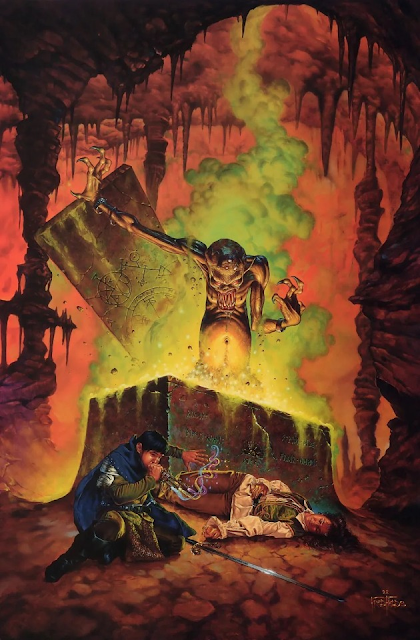
For comparison, check out another Fred Fields piece. The guy can paint and can nail an exciting composition.


Sunday, December 5, 2021

This One Goes to 14


As you might have noticed... I have some B/X D&D on the brain these days. I was worried... for a time in recent months I simply did not have it on the brain. Burnout? Probably not. I don't really "burnout" on something. I get distracted.

OD&D is a beast with which I am familiar only through the osmosis of reading blogs, FB posts, Twitter, and listening to a bazillion podcasts about the OSR. I understand what it is, I know it's rules, generally, but I'm unfamiliar with it intimately and have no nostalgia for it. I never knew much about its existence until much later in life, to be honest. No one I knew who was into gaming back in the 80s ever mentioned it or owned it.

What I did have intimate experience with was B/X, BECMI, 1e, and 2e. That's my era, due to the age at which I bought my ticket to ride (13-14). The first one I played was B/X. The first I owned was Red Box. It was all glorious, of course.

Anyway... levels.

Peeking into OD&D I can see that Fighting Men were given levels through 9, Magic-Users through 11, and Clerics through 8. I don't believe there was any sort of level cap or anything, it's just that they only included those levels. Those books are a shit show of organization - a beautiful shit show, of course. I am an old school zine kind of guy so you would think that I'd be all over OD&D's gritty photocopier aesthetic. And I do admire it! But it's not my D&D so it's hard to get a boner about it.

Add to that the fact that even though B/X is far better organized, cleaned up, and codified it is still a fairly crude book by today's standards, right? Who the fuck uses that garish Souvenir font anymore?? (hint: I do).

So what was my point here? Oh yeah... this one goes to 14. And I think that's super important.

Going to level 10ish is fine. Going to 18 or 20 (AD&D's range, from what I remember, and the range of 5e) is fine and dandy too. Going to 36 is BONKERS. What was Frank Mentzer thinking? (well, the 36 level range had already been promised so it wasn't his idea... he was just fulfilling it.)

14 levels is basically perfect. You have your sweet spot at lower levels, some access to real power, and a nice place to say "We've done it. Let's roll up some new level 1s."

There are other reasons, though. It's hard to hold 20 levels in your brain. What does 14 mean in the context of 20? But 14 fits nicely. I know that getting past 7 means you're a big fuckin' deal. Getting to 14 means you're a god damn existential threat. After all, even though 7th level spells aren't in B/X (and maybe they fucking should be), given the logic of the Magic-User's XP table, they should be slinging 7th level spells at level 13. Mass Invisibility... Charm Plants... bring it.

There are 7 classes in B/X. Characters can get to level 14... 14 is 7 x 2. This means something.

Ok. Time to wrap this up. I'm rambling. Next up, the B/X 64 Challenge! Write and publish a 64 page (or 32, or 48) book for B/X within a year. Stop just thinking about it. Do it.

Saturday, December 4, 2021

Hawkhead

Part of the Doomslakers B/X project. 


Hawkhead, +1 sword: User can see through the eyes of a passing bird for 1 turn (10 minutes). During this time they cannot see anything else.

This sword was forged in Nylar before the city fell to ruin. It was made at the behest of the legendary hero Makkus the Mark whose clarity of vision and steadiness of hand was unparalleled. Perhaps this blade currently rests in a pile of treasure in some forgotten tomb or in the hands of some troll or scoundrel haunting Hill Country. Where the famous bow of Makkus rests is a mystery.

Some say the voice of Makkus may be heard by worthy warriors who heft this sword in battle.

Saturday, July 3, 2021

Rock Hardy Book of Dwarfs (Idea)

I'm working on a dwarf book. Working title is The Rock Hardy Book of Dwarfs, but that might change. My concept is to make this a black and white PDF and POD 48 pager. It is possibly the first in a series of setting books that very crudely describe my "traditional" fantasy setting of Yria. Basically most of what you find in the pages of Black Pudding would fit here.

Right now the book is at 9,000 words with a loose target of 10,000. So I could stop any time, clean it up, and finish the art. Like everything I do, this is meant to be an idea packet, an inspirational booklet. It will not be "complete" in any sense. It will be broad strokes, heavy on color.


The Rock Hardies are a mountain range in Yria where redneck dwarfs dwell. They like to fight, make and drink beer, and think of ways to win back their ancestral city of Frimmsreach.

All of this is subject to change per my whims. But as it stands, the book is compatible with B/X (Old School Essentials). It includes a lot of dwarf social stuff, beer, mountain monsters, etc. I certainly have toyed with the idea of making it a Troika! book or putting a Labyrinth Lord logo on it. Or even some other game engine or even completely system neutral. But honestly this was always meant to be a B/X setting* and I can't think of a compelling reason not to follow through on that.

I'll post more when I have more.

And yes, the Supercalla follow up is still on the table. Hellion Cross will see its day.

*B/X with a healthy smattering of advanced material, natch.

Thursday, March 18, 2021

Fighter/Assassin

Complete in his raw glory, Decius Vladrumir, Cobold Ftr/Ass.

This is waaaay old. I found it among all my oldest RPG junk. This is a typical character sheet for me from that era of my life. This would have been maybe 1986, about 2-3 years after I discovered D&D. I borrowed the AD&D DMG + PHB from a friend and copied a lot of stuff by hand.

I was versed in basic D&D and only just flirting with AD&D as I was probably just about to enter my first "real" campaign with friends and we were definitely using that witch's brew of mixing all the rule books into a pot and sipping. So on this sheet you can see he is dual-classed, for example.

I'm curious about the upper right hand corner. Bare hand combat. I suspect this is take from one of the D&D box sets bc I remember that whole "weapon equivalent" thing, perhaps from the Mystic class? I'm not sure. It's been a long time.

Cobolds were a race from my Midaka setting. Basically a riff on dark elves, but they were distinctly blue-skinned.

Art-wise, this was early of course and at this time I was definitely using nibs and bottled india ink for most things. Messy, scratchy. I did this for a few years and have rarely "dipped" back into it.

Favorite part: The AC table. I preached about how descending AC is fine and easy and all you need is that table on your sheet so it's nice to see that I was walking the walk even back then. Though going to -14 might have been unnecessary. Chalk it up to flipping through Legends & Lore (Deities & Demigods) more than ANY other D&D book.


Saturday, March 6, 2021

Al Qadim Again


I've posted many times how much I love Al Qadim. I have been collecting the books for years (not finished yet, but getting close), but really I've only played in one Al Qadim game one time in the mid 90s and I've never ran it. Maybe I never will.

An interesting thing about this setting is just how inaccurate it is to Arab culture and the mythos in which it plays. For example, my understanding is that the tales we call Arabian Nights are actually Chinese in origin (?), not Arabian. but folks in the Arabian world, having also grown up knowing about these tales, assume they are Arabian. There are lots of other culturally inaccurate ideas in the game that you can Google for yourself.

I'd love to say these things don't matter because it's an elf game. And... yeah... I mean, mostly that's true. But we'd be fools and - worse - assholes if we totally ignored it. This is a game series based on a distinctly American male's idea of what Arabian fantasy is. More specifically, it's based on a certain generation of American males: mine.

When I was in first grade, c. 1976, I remember our little asses being marched into the school's auditorium to watch a movie. I remember it vividly because we were arranged from shortest to tallest (so people could see over each other, natch) and I was second in line. The only person shorter than me was Vickie and her pigtails. I loved Vickie. Being placed next to her in line, for me, was an early romantic experience that filled my wee mind with ideas. I was her "taller man".

Anyway. That's not important. The fact that she ignored me is meaningless. The point is we watched the 1963 classic Jason and the Argonauts, then only a little over a decade old. It was phenomenal! Warriors, ships, giants statues, skeletons! My mind reeled with the imagery looming over me.

This has jack shit to do with Arabian Nights, but it's this sort of movie, along with mummy movies and other adventure flicks, that fueled the imagination of Jeff Grubb, author of TSR's Arabian Adventures setting book that launched the Al Qadim campaign series.

Jason and the Argonauts, the mummy movies, Sinbad, the Thousand and One Nights... these are the sources for Al Qadim. Arabian mythology and history are really a distant second. The setting is a hodge podge of middle-world cultures and ideas, all filtered through the brain of a white male American riffing on ideas that inspired him in the 60s and 70s. And it's fucking fantastic! I love Al Qadim, for what it is. Warts and all.

But I understand that folks from middle-world cultures might find the work irritating or even mildly offensive. I don't believe it is egregiously so. Jeff Grubb and crew did a bang-up job of doing the best with what they had and genuinely trying to make a setting that lovingly and respectfully approached the material. But it was by and for white Americans, so any actual near-east perspective is not really present in the work - and that is one of the things that must be kept in mind when exploring it.

This is the subtle point that people miss out on when they complain about "cancel culture". Nobody is running around screaming "cancel it!" like the right wing media machine wants you to think. Rather, things we took for granted are being examined from new perspectives and sometimes that means something old and beloved has to be re-evaluated if you want to be intellectually honest and socially responsible.

You can still love the shit, so if you feel some sense of outrage welling up just tamp it back down, kiddo. Enjoy your magic carpet ride, just don't forget it's complete fantasy.

But hey, maybe check out this video series that goes into a lot of depth on the topic. They talk about these issues more broadly, from a modern perspective, so don't go into this expecting a short review of Al Qadim. You ain't gonna get that, buster.

EDIT: And I want to say for sure that I 100% accept that this series has serious problems. No defense will come from me on that front. This is probably why, even though I own this and still collect it, I have not ran it. I could have easily ran this setting long ago. Still I don't.


Sunday, February 14, 2021

100% True Story

HOW DID YOU GET INTO GAMING?

It was 1984, I was 13. I had a crush on my math teacher, Mrs. Kendall. She was a short, plump woman with chubby red cheeks and an overbite. She had these delicious black rimmed glasses and wore simple dresses. But they were snug enough that her ample curves couldn't help showing through. I was 13. I noticed this shit.

Anyway. Um... one day after class I stopped to chat her up, like you do at that age. I was putting on my moves, talking about Conan comics and she clearly wasn't into it. She was rushing me. Time to leave. I got the message eventually and left the room with a cool swagger, pushing up my glasses to show solidarity.

In the hall was my buddy Sam talking to this tall dude I saw around but didn't know. His name was David and he had in his hand a thick biology book that contained no references to evolution and this other book with the fucking weirdest looking creatures on the cover I had ever seen. Title said "Monster Manual". It was some next level strange bullshit. He also had this little blue ball in his hand... like tiny. Like a toy. Kept saying it was a "20 sided die", which sounded like complete nonsense to me.

Well, turns out that book was for this weird board game without a board called Dungeons & Dragons. He was looking for some players and Sam was volunteering us to join the game. As it turns out, I remembered Mrs. Kendall one time talk about a game like this where you used numbers to represent character traits. Like you'd have a strength score or something. She seemed to think it was a useful math tool or some shit, so I was like in my head going "This could be my way in" so I was like "Yeah man, let's play."

So we did. I played a character (you make up characters) called Beano the Cheesey Wizard. David, who was the MC of the event, didn't seem to love that name but he was like "whatever, just roll for initiative". Beano was kind of a skinny, weak, silly asshole who wore a fedora and carried a big sword. Now... here's the thing about the game. Wizards couldn't use swords. David said I couldn't have a sword and I said the price list says 15 gold pieces and I have 48 so unless the shopkeeper shoots me, I'm buying a fucking sword.

I got the sword, but wasn't allowed to use it. I know, it's fucking stupid. But the rule book says I can only use a dagger, dart, or staff. I mean, in the words of Lars Ulrich, "they don't actually put anything there to stop you, like spikes"*. So I carried that fuckin' sword and made a point of threatening people with it as often as possible. But the MC was stubborn and would not let me use it. I played this up. "Beano tries to draw his sword but some invisible force stops his hand. He struggles against it... clenching teeth and pushing at the force but to no avail! Frustrated, he casts Magic Missile instead."

Beano was killed by kobolds who laid a pit trap. Poor bastard fell in, taking 6 damage... 4 more than his hit point total. Then a kobold shot him with an arrow for 6 more and he was at -10. Apparently, according to the MC, -10 is a big deal. I said "Look, I'm fine with Beano being dead. I'll roll up a dwarf named Cormac Mac Daddy. But if this shit doesn't get me to second base with Wanda Kendall I'm telling people you shave your nads."

David lit a cigarette at that point. Not uncommon back then. He was older, maybe 17. I remember Toto playing in the background when he looked at me and said "That might play well with my rep.". Someone, I think Jesse, knocked over a can of Dr. Check at that point, spilling it on the Monster Manual. Not sure what happened next, but it's not important. I did score that copy of the Manual from David later that year by trading issue 107 of Savage Sword of Conan. I didn't mind the Dr. Check stains, but it pissed me off that pages 17 and 18 were stuck together. Seriously, David? What the actual fuck.

When I relayed the story of Beano to Mrs. Kendall she smiled, nodded, and said "Ten foot pole could have found the pit trap." I believe the "ten foot" comment was a phallic suggestion, honestly. And, if I'm being straight, it kind of put me off a little. Like... what was she suggesting anyway? Feeling incredibly self-conscious, I stopped making moves on her and kept our potential affair to myself for private time. "Tow the line, love isn't always on time", right? But I still kept playing in David's D&D game. Cormac made level 3 before succumbing to a roper's grasp. His sister, Fanny Doodle Mac Daddy, inherited his +1 war hammer and lived on to see level 9.

That is the truth, I swear it. Every detail.

*He was talking about driving between the lines.


Saturday, January 2, 2021

Skillzzzz

It is well known that because OD&D did not have an explicitly-named skill system many grognards are opposed to games having skill systems. I get it. I jumped the ship from D&D in 1990 and landed on GURPS. I get skills. I get why they can be sort of... blech.

(I am not a fan of GURPS, though I was super into it for a few years. Love all the books, though.)

D&D had skills embedded in the classes and equipment and there were a few nods to skills, such as AD&D's Secondary Skills. In BX, a fighter was able to use all weapons and armor. Those are some mad skills! A thief, of course, had an explicit list of skills (which which they suuuuuucccckkkeeeeeed.) A magic-user had the skill of casting spells and being able to create new spells and magic items. Etc.

Equipment also granted a skill-like ability to PCs. If you had a 10' pole you had the skill of being able to prod at a trap from a safe distance. A PC with a lantern had the skill of lighting a dark room - a huge benefit.

AD&D, and also BECMI's D&D line, had lots of weapon skills.

The thing that I believe grogs have a problem with is when a player says "I roll Perception. What do I see?" Instead of saying "I look around the base of the statue. Has it been moved recently?" and so forth. The former represents reduction of the fiction to a straight mechanic while the latter represents clever puzzle-solving and more immersion in the fiction.

Of course both can exist together. After examining the statue, the DM might ask me to make that Perception roll. Maybe they already know that I'm gonna see the scrape marks but maybe there's something else to be seen - such as a trap switch - and the dice roll will indicate just how closely my PC looked.

BX D&D gives the advice of using ability saves (we call 'em checks nowadays) for those moments where there isn't an established mechanic. This is a default skill system wherein the ability scores coupled with the class determine what types of skills you are good at. The party magic-user, with their high Intelligence, should to a better job of recognizing weird items and knowing esoteric lore. The cleric's Wisdom should let them know more about obscure cults and shrines. And so forth.

One way that the use of ability checks (and default skills in modern D&D) can frustrate players is when a character who isn't the party's authority on a topic is somehow just better at dealing with that topic. For example, maybe the thief has a particularly good Intelligence and the wizard is only average. If the DM allows the thief to make Int checks for every weird thing they encounter, the player of the magic-user might feel slightly useless. "Oh, Niff the Nimble rolled well under their Int so they know a good deal about this weird order of Purple Wizards. But Jan the Sorcerer failed that Int check and knows nothing. Again."

The solution to that problem is don't let Niff the Nimble make Int checks for things in which they have no expertise. And when you do allow it, follow Moldvay's advice and give them a -4 penalty. Let that middling wizard have a moment to shine and maybe even forgo the Int check now and then. "As it happens, Jan has heard of the Secret Society of Super Wizards."

A bit of ramble here as I basically think out loud about skills. More to say, but I'll do it later.


Saturday, April 4, 2020

Init, Innit?

(Get it?)

So this whole initiative thing in RPGs. And please understand here I'm talking about the kind of RPGs wherein who gets to bash a motherfucker's teeth in first actually matters. I don't care if you don't need initiative systems in your Saved By the Bell RPG.

(Not sure if that sounds like a fun game or not...)

For reference, I talk a bit about initiative here, here, here, and here. So this has been on my mind a bit.

You see, it's all quite simple.
I don't like initiative. It gets in the way. It takes time. It slows things down. It is complexity that doesn't always add much to the game. But I have a really hard time imagining a game wherein there is combat and you have no method for deciding who gets to roll the dice next. So this post is me thinking out loud about the problem. It will meander. Click away while you still have the initiative to do so.

Here are the types of initiative systems I am aware of in RPGs:

1. Sides

1981's D&D codified the vague initiative system from previous versions into a very slick and simple method. Each "side" of a battle (frex PCs vs. monsters) rolls 1d6. Whoever gets the higher number goes first.

This is the method I've used most. I've played and ran a ton of old school D&D (via Labyrinth Lord, mostly) and this method, out of all the methods I've tried, works best. It is fastest and smoothest. Embedded within this method is the idea that you can work out the details on the fly. Because knowing that the PCs go first doesn't tell you which one goes first. You have to sort that out. In our Monday night Doomslakers group it works like a charm. We have mutual respect and we appreciate the story that is being told. If it feels like I should attack first, then I do. It works.

As a caveat, you can allow individuals to add their Dex mod to side init and that works fine too. So it might be the case that the PCs lost init, but Dex the Speedy, having +2, still goes first.

2. Individual

This is the most common method in D&D type games. It is the only method I've experienced when running or playing anything approaching a modern game. It is the default method for DCC RPG, for example, and for all modern iterations of D&D. And I hate it. It is the slowest method I know of. It involves the highest degree of GM-workload. And it is the most popular with common RPG players.

Is that because it's good or because it's just what people know? I suspect the main reason for its popularity is that it caters to each player's sense of individuality. It is not a group effort, it is my effort. I am fast. I am lucky, etc. It recognizes individuals. Which all sounds great, but fuck's sake it's a time sink.

I would declare my intention to never use this method again except that a lot of games have perks built into the initative system. DCC RPG has Initiative as a stat on your sheet. Ditching the method is probably OK, but you would need to consider how it impacts PCs.

I am a special goatflake!

NOTE: I have nothing to say about AD&D's initiative method because frankly I have never known what it is. Something about rolling 1d10, lower is better? Even when I was playing that game in high school I have no memory of how we did init! I suspect we did d6 side init.

3. The Sack

Daniel Sell's Troika! has a clever init system wherein you select objects for each PC and each monster then put it all into a sack. You draw out an object and that tells you who goes next. One object represents end of round.

Reach into my sack.
I actually bought the initiative cards for this game and used it when I ran Supercalla. It worked fantastically well for me as GM. It reduces workload to almost zero. I like it quite a bit. But I do not believe the players loved it. This is because it is entirely possible for a PC to go a round or two without taking any actions. And that probably feels shitty.

It also leads to irrational results. Frex if you had two guys duking it out in mid-air and someone else trying to disarm a bomb. What if you draw the bomb dude's card twice in a row, then end of round, then bomb dude again? Are the two combatants just hovering in mid air, waiting for their turns? Sure, you could GM fiat that shit and just say who goes next. But I like to stick with a game's rules as closely as possible and having to do such a thing indicates something might be slightly broken about the system.

4. Preset

Some games use a preset init system. Frex: Holmes' 1977 D&D had a system in which your Dexterity score determines who goes first. For monsters, you'd roll their Dex on 3d6 and go. My recent first experience with Warhammer Fantasy Role Play indicates that in that game you have a set init score and you just go in that order. Our group monkeyed with Cadillacs & Dinosaurs once and it felt like that game also had a kind of fixed initiative (but phase-based?).

I'm OK with these methods. They do the job of removing GM workload and avoiding all fiddly questions. Initiative is pre-determined and you just go with it. The downside, I think, is that it leads to some possible absurdities and that it makes combat more predictable. As an absurdity, what if your PC with the highest init by a country mile is at the rear of the party as you burst into a goblin den? That guy is going to shove past everyone, get out front, and land a blow first? Maybe. Sure. But perhaps that slow little dwarf who kicked down the door will bury their blade in a goblin throat first? It requires GM adjudication, does it not?

But to me, making combat predictable is a bigger sin.

His init was highest. Alas, he was last in line.


5. Phases

Some games have a phase system. I am not nearly as familiar with this. I know that Villains & Vigilantes had this method, and I believe the above mentioned C&D had one. My limited, pitiful understanding is that you would basically count down from some number, such as 10, to represent a combat round. If your PC's attacks go on phases 2, 4, 6, and 8 then you'd get 4 actions. If Mine is only 6 then I'd only get to go when phase 6 was called out. This is more-or-less the same kind of method as #4 above, but with caveats.

It's a neat idea.

Not phased.


Eat me.
6. Popcorn-Balsera

This method is based on a method used by someone named Leonard Balsera and was written into Marvel Heroic Roleplaying and later into FATE as "elective action order". I like the term "popcorn imitative".

All it amounts to is you somehow figure out who goes first then that person decides who goes next and when everyone has gone, you start over. I can't imagine that this method hasn't been used countless times in organic play over decades. I know for a fact I have defaulted to this method in games over the years, without calling it out as a method. It's just a natural way to play.

And I like it. In my other blog posts about Sand in the Bone/Dead Wizards I talk about this a lot. What I'm going for is a slightly more codified version in which there is some GM dice rolling used to decide when/if enemies get a turn between each PC action.

7. Troll Style

I never owned, played, or even read Tunnels & Trolls. So I only recently became aware of it's combat system. In it, there is no initiative. Both sides just make one big attack roll and the loser takes damage distributed between its members.

Of all the methods, this one seems to reduce combat to the simplest approach. It feels like it would be fast and furious. But at what cost? Would this method sacrifice granularity and detail? What if you had a bunch of farmers with pitchforks and one armored knight against a battalion of bastards? Would the knight's side constantly lose the roll, taking damage every round while no damage is dealt the other side? The knight lands no blows?

Of course that interpretation assumes that damage is related to actual physical strikes instead of being purely abstract, a representation of morale and fatigue. Either way, interesting.


8. None

Of course you don't have to have a codified method. You can wing that mother. GM fiat, player negotiations, etc. But I think it would be wrong to refer to this as having no system. You will always have a system. Even if you decide what it is round-by-round. Having no written method only gives you an illusion of winging it. I guarantee that by the end of one combat you will have your method and you'll use it again, until it becomes a problem.


And that's all the various initiatives I know about. If you know of other methods that are distinct, tell me about them.

Saturday, March 21, 2020

The DM's Notebook vs. The Campaign Bible

Over on this post, Froth sagely points us to this post by The Angry GM about a delicious little idea called the campaign bible. A campaign bible is just your GM notebook filled to whatever degree you deem necessary with your notes about the game you want to run or are running. You don't show it to anyone because it's yours and it's a mess. You don't write it for anyone to read. You don't write it for publication. It is a tool. It is called a bible because it's the repository of reference information necessary to make your campaign good.

Sweet idea.

Today I happened to pull the old TSR World Builder's Guidebook (Richard Baker, 1996) off the shelf. What a wonderful little saddle-stitched tome this is. Not only is it chock full of useful tables and ideas for creating a fantasy world, but it's got the best of the late-era TSR page design going on. The headers and callouts are color, the art is monochromatic, the tables have that nice gray bar thing going on. It's a solid book if you can score a copy. You can get the official PDF here.

As a sad side note, the artist who illustrated this book, Glen Michael Angus, died in 2007. He was born the same year as me and his work was very stunning. I'll post a few pieces from this book below. R.I.P. Glen Angus.

Anyway, I'm flipping through for ideas when I hit page 4 and Baker tells us that we should definitely keep a DM's notebook. This is a great example of the idea of the Campaign Bible expressed in an official AD&D product 24 years ago, which is pretty cool. I'm guessing there are other examples even older, perhaps in the pages of ye olde Dragon or perhaps White Dwarf, but I don't know as I'm not an expert on the matter.


Baker's bullet list is pretty good. If you followed his advice to the letter, you'd at least be a well-prepared GM. I particularly liked his inclusion of a "tickler file" where you jot down the various goals, desires, and needs of your Players' PCs for use in adventure design, with the nod that Players might be more interested in adventures that ping their individual or group interests. Sage indeed.

So how does Baker's advice compare to The Angry GM? The Angry advice is more random, more angry, more visceral. And I really loved this bit right here because it's truth:

Creativity is what happens when random things bump into each other in your head and form some kind of connection.
Also, this hits home for me because I have always kept such fact sheets myself:

A fact sheet is a sheet of facts. Short, succinct lists of informational bits and bobs. Not prose. If you can’t master the vital skill of distilling things down to the important points and removing the excess crap, you can’t communicate effectively. Quit GMing.

The Angry GM gives you many more reasons to keep a bible while the Baker entry is short, sweet, and to the point about what you should include in it. I don't think these two things contradict as they are clearly talking about the same idea, just 20+ years separated in time and with wildly different formats. Both have one goal: to make you a better GM. Noble.

Here's an oldie: The Dungeon Master's Design Kit, for AD&D 1e. I never owned this. But it's got a lot of form sheets for the DM to use in creating NPCs, monsters, encounters, chases, and big ass finales. Sounds great. Given the nature of much of the official material of the time, I suspect it is dry and wordy and not very compelling. But I do see a fair number of random tables, so that's a plus. And who the fuck is going to fill out a whole one page form on a single chase scene before it happens? Talk about a bit of a railroad approach. I guess this was the era of Dragonlance.


And check out that badass art by Glen Michael Angus!

As to my own version of the DM's notebook/campaign bible, it's not well organized at all. But I do have some habits I've been following for many years.

Prior to the internet, I always kept a literal file on each major project. Inside the file would be various sketches, maps, and notebook sheets scrawled with madness. Before that I would use spiral notebooks to draw and write everything in. And I was kinda obsessive about keeping things separated. I wanted a different notebook for each idea. Most of them were filled with blank pages buffered by 1-20 pages of actual notes.

Post-internet, I started keeping digital files exactly the same way: filled with sketches, art, reference pictures, and various word docs and spreadsheets (these are my fact sheets, per the paragraphs above). Today I tend to keep my docs and spreadsheets on Google Docs or in DropBox so I can get them at work. I always have a spreadsheet and I have even named them "bibles" in the past. They contain lists of names, places, and ideas for the thing, along with random tables.

None of this stuff gets shared. Not because that's a rule, but because why on earth would you share your own personal random scrawlings? The stuff you share is what comes out of those scrawlings. The adventures you run, the finished art, the finished books (if you're publishing). You don't share your bible stuff. It's fuckin' ugly.

Swipe File

One thing I would add to the notebook/bible concept is the swipe file, a term I swiped from the comics industry, who apparently swiped it from the advertising industry. Whatever the history, my use of the term is very simple. A swipe file is a file full of images and ideas that inspire you or have the potential to inspire you. I find this a highly valuable tool for creative work. I tend to keep multiple digital files full of stuff as well as private Pinterest boards and other such nonsense. When I'm feeling slow, I browse the files and see what gets drummed up in my brain. Never be a afraid to borrow and steal little nuggets from other creators because they damn sure did the same thing and anyone who tells you differently is a fuckin' liar. Nobody makes shit up whole cloth. Nobody.

Glen Michael Angus

When I Googled Glen Angus' art for this book I got nothing. Nada. Zilch. He did work on M:tG and other TSR books, and some of that comes up, but I wanted to showcase his work on The World Builder's Guidebook. So I scanned a little bit of it. Here are a few images from the book by the late Glen Michael Angus.


Monday, February 24, 2020

Alignment Tongue Lashing

Law vs. Chaos!? DAT rocked.

Alignment kinda sucks. And it's also kinda awesome. But mostly I'm leaning toward the suckage. With caveats.

Here's my entry point to alignment.

B/X description of Law as "good".
I got my dirty paws on D&D red box and devoured it. I grokked the alignment immediately in the simplest terms:

Lawful is good.
Neutral is neutral.
Chaotic is evil.

This scheme is explicitly stated in both B/X and BECMI editions of D&D. I have heard people argue on the interwebs that alignment in classic D&D should not or does not map onto a moral code, but is rather an adherence to some kind of cosmic battle plan of Law vs. Chaos. This idea comes from the ways that these notions are used in various classic fantasy stories, such as those written by Michael Moorcock. And I get that. I guess in original D&D that was the intention, or at least a strong inspiration. But very quickly they started mapping the "bad" monsters onto Chaos and the "good" ones on the side of Law. Then they made it concrete in both B/X and BECMI: Law means good, Chaos means evil. Done and done. Easy to grok.

If we go back to the original game I think it's still very clear that Law is good and Chaos is bad. On page 9 of Men & Magic there is a table showing which alignments are suitable to which races/creatures. Would you say that being in the company of ghouls, evil high priests, vampires, and mummies makes you kind of "bad"? Yeah, I agree. It does. So Chaos is evil even in original D&D, no matter what a few grogs want to argue*.

Holmes took things to a new level.
In 1977 Holmes complicated matters by introducing another axis to the alignment table. Now we have not only Law and Chaos, but also Good and Evil enter the picture explicitly. I am less familiar with the how and why of Holmes D&D as I never even laid eyes on this version until 2012 or so. I didn't know it existed. No one I knew had it and I don't remember seeing ads for it. I came into gaming in 1984 so I guess I missed the boat on that one, along with original D&D, which I also never laid eyes on until 2012 or so. That's right. Actually my first visual treat in RPGs was the DM at school and his 3-ring binder containing B/X rules. Imprinted for life.

With Holmes, our 3 alignments become 5: Lawful Good, Lawful Evil, Chaotic Good, Chaotic Evil, and Neutral. This is weird because Holmes is, arguably, the first iteration of the "basic" D&D branch of the game, which adheres to only Law, Chaos, and Neutrality. Holmes is the only place the 5 alignment method is ever seen.

Holmes' system definitely breaks the whole Law = Good structure. Because now you can literally be Lawful Evil. What does that mean? It means that being Chaotic now doesn't automatically make you evil. It makes you unpredictable and maybe selfish, but not a total cunt.

Holmes' method was more sophisticated than the simple 3 point system, but that wasn't complex enough for Gary Gygax. So when the AD&D Players Handbook dropped in 1978 the world was formally introduced to the now-classic 9 alignment system. This is the one I came to glom onto when I was running and playing D&D in the mid 80s. It's a very intuitive system when you think about it. It's clearly a way to map alignment onto morality and behavior. I would argue that any notion of alignment being connected to a cosmic struggle is annihilated with AD&D. Here if you are Lawful Good it means exactly what you see on the tin: you want things to be orderly and you prefer to do good instead of doing harm. If you are Chaotic Evil you're the opposite of that: burn the church with the people inside, take a dump on the steps, and steal a car to get away.

Here, this Nic Cage schematic kind of sums it up. Sort of.


When playing in 1e style games I tend to favor Neutral Good or Chaotic Good alignments. I dislike LG and have no interest in being evil. I don't really get neutrality here. But that's ok.

Alright, so that's my history with and understanding of alignment. Now what am I doing with alignment today?

Nothing. Because it sucks. And leaving it out of the game has zero impact. Hell, I wasn't even aware that I wasn't paying any attention to alignment until I actually thought about it.

But there's a caveat. Games like DCC RPG, for example, do a very nice job of making alignment matter. In that game it is allowed to be simple 3 point alignment and it is pretty explicitly described in those broader, cosmic war terms... not in terms of good and evil. So in DCC I think it is far easier to play a chaotic character who isn't evil. And there are nice mechanical reasons to use alignment in that game. If you're a thief, your skills are linked to your alignment. When clerics Lay on Hands, they heal you differently depending on your alignment relative to theirs. Touching weird statues may impact you differently if lawful vs. chaotic. It's a cool little mechanical knob you can pull and play with.

In D&D not so much. There are some magic items that impact or favor alignment, and there are alignment restrictions on some classes (depending on version), but other than that it's really just a useless bit of wasted space on your character sheet. Fight me.

*Much love to the grogs. Keep on keepin' on, just recognize that you're wrong, based purely on text.

Here I am talking alignment.
And here I am again.
And once more, probably contradicting what I said on this post.

Wednesday, February 19, 2020

What Happened to the Androids and Orgies?

I am absolutely not a scholar or historian on the topic of the history of D&D. But I have burned through enough podcasts and blog posts to know a few things. And I know that way back at the beginning there were androids and there were orgies.

There were also demons, devils, and demigods you could fight and - arguably - slay since you knew their AC and hit points. Times change, don't they?

Mix it up, Erol Otus.

In those heady early days D&D was a tiny little weirdo game that almost nobody knew anything about. It seems like even the people who knew about it and played it didn't know much about it since the rules were cryptic as fuck. In those days, flying way under the radar, it's easy to see how you could get away with having a harlot table in your core rulebook or writing an article about orgies.

(Not only cool shit like an orgy article, but also pretty bad shit like the way they tried to make ability scores align with real-world assumptions about men and women... as if playing an elf game had to be physiologically "realistic". Thanks Lakofka. I'm glad the idea didn't take much root and I'm happy D&D today is explicitly inclusive.)

Fast forward a decade. Hoo-boy, how the times changed. I was a teen in those days. I remember quite well the motherfucking PMRC. I was one of those rural white boys headbanging to Grim Reaper and W.A.S.P. and Ozzy as they lashed out against the prudes and crispies and censors in their music.

(On that note, check out the Filthy Fifteen playlist and rock out.)

(Also, it is not lost on me that the response from the rock and metal community wasn't just about taking a stand. In those days, making an angry song against Tipper Gore was a sure fire way to sell a lot of records. Also, fuck Tipper Gore.)

Darlene
In the mid and late 80s, TSR, publishers of ye olde D&D in its many forms, were a bloated corporation fat on the sudden and super popularity of their product (you don't get a Saturday morning cartoon easily, remember), yet beginning to flounder and fail as a business. They were trying to play it safe. They were trying to duck the Moral Majority's deadly knives by nipping and tucking the fuck out of D&D. Gary Gygax was tossed out of the company and the new controllers were not interested in fighting a culture war. So when the now 15-year-old game was revamped to it's official second edition, they did a little house cleaning.

No more demons. No more devils. No more gods with ACs and hit points (at least I'm fairly sure about that one... am I wrong about that? Huh). Definitely hells to the no on titties, booty, and orgies. There is no harlot table in the 2e DMG. No ice devils or beelzebubs. No naked succubi.

Likewise, by this time there was no more getting the chocolate of "straight" fantasy into the peanut butter of science fiction. You would no longer find androids in the monster lists. The high fantasy genre had gelled into a money-making monster as the new game in town were trilogies of fantasy adventure novels and trilogies of trilogies of fantasy adventure novels in which not a laser pistol nor a robot was to be found.

It all felt so god damned vanilla.

And hey... let me be absolutely clear about something. I would not want a harlot table in my new DMG, unless it was utterly gender neutral or wildly gender diverse. Men are harlots too, you dopes. So this is not some cro-magnon argument for returning to the "good old days" when "men were men". Fuck that noise in the ear.

All I'm ranting about is how the influx of attention and money tends to skew the deliciousness and quirkyness of content toward the mean. The middle. The boring-as-fuck.

I'm guilty too. I have, on numerous occasions, mitigated, rounded, smoothed, watered-down, and toned-down my own shit before putting it out in public. This is largely because I want to be liked by as many people as possible. I don't publish stuff simply because I want to have stuff published. I want people to like what I do. I want everyone to like what I do. And that, my friends, is a problem. You cannot please everyone and trying to do so leads to the great big boring land of Milkquetoastington.

"You mind? Peeing here."
I have worked in Milquetoastington. I have contributed to its off-white towers and trimmed its creme picket fence lines. I don't enjoy it. And what I don't enjoy I figure nobody else is going to enjoy either. I try to create based on the philosophy that if I love what I'm doing then at least one person on the planet will love it. If I don't love it, then I can't assume even that much.

I don't make resolutions or promises. I know myself and I know I'm prone to going down different paths on a whim. I allow myself to wander. I try to steer myself, I try to work at what I'm doing and have pride in it. But I don't make resolutions. So this is not a resolution to be less filtered in 2020. It is, however, a public acknowledgement that I have filtered myself in the past and since I didn't like my games or music being filtered I should probably not worry so god damned much about how many people like me. Without being a dickhead, I just want to be me. I'm too damn old to be anything else.

/rant


Saturday, January 25, 2020

Gary Con XII GM Shirt

Once again, I drew the Gary Con GM shirt for 2020's Gary Con XII. Once again, I probably will not be at the con. I wish it was closer so I could drive up for a day or so.

Anyway... here's a white dragon based on Larry Elmore's excellent con art! It was super fun to do this, as usual, and I'm proud to be a tiny little part of the thing I love so much. Thanks to Luke Gygax for continuing to ask me to do the GM shirts. I hope people dig 'em!


Here are some previous years' shirt posts:

Gary Con IX

Gary Con X

Gary Con XI

EDIT: I did a fifth GM shirt, the first one I did for the con. But for some crazy reason I have lost that art. There are no files to be found. I do see some images online of the shirt, which you can see below. This one was sketched by Jim Wampler, who was slated to draw the shirt. If I remember correctly he got too busy and I stepped in to help out. And now you know the rest of the story.


Sunday, December 15, 2019

That RPG Folder You Accidentally Put in a Delete Me Folder

Continuing this series.


Maximum HP is a 1e style RPG zine by Lloyd Metcalf and Raven Metcalf chock full of goodies. This issue seems to be mainly about dwarves and a place called Dwarfhome. Lots of NPCs, description of a village, an adventure, etc. Good stuff for a classic AD&D night. Lloyd and Raven do up the art nicely too.


Rubik's Cube Character Stat Generator by Goblin's Henchman is a weird little ditty. It's a clever way to generate PC ability scores with a cube. Fast and simple. I can imagine players totally abusing this, especially if you give them any time with eyes on the cube. But still.

Friday, June 21, 2019

Labyrinth Lured: A Place For Lost Stuff

I'm thinking about taking my collections of Labyrinth Lord detritus and transforming them into a monsters & treasures type book. I think I'll call it Labyrinth Lured because it's clever. Then later I might do one that's more saucy and naughty and call it Labyrinth Lurid. Because that's also clever in an annoying way.

Here's a mock up of what the cover for Labyrinth Lured might look like. Just imagine it in stunning 256 million range Technicolor™ for the full effect. Picture an interior chock full of nasty boogers and gaudy baubles. Maybe some of the LL character classes I've been far far too lazy to do for Black Pudding, such as the Dazzler and the Mentalist.

Saturday, May 25, 2019

OSR Weapon Damage


The topic of weapon damage comes up from time-to-time in OSR discussions. I think this is because we want that beefy fighter to be so very deadly with big-ass swords and we want that wee dagger to be more lethal than it is.

A lot of folks are in favor of straight 1d6 damage per weapon, as it was in OD&D. I hate that idea, but I get it. It means that the dagger is a better choice than it normally is and it allows players to be creative with their weapon choices since there's no mechanical penalty for those choices. But it also means - since all things really are even - weapon choice is virtually meaningless in terms of mechanics. Your skull-tipped mace and my super sharp scimitar both act identically in combat. I dislike this immensely.

Caveat: (Important caveat, no less) A good DM and player rapport will cause the nature of a PC's weapon to enhance play. My choice of a scimitar vs. your skull mace may mean that the Arabic-inspired setting has more respect/acceptance of my PC vs. yours. Perhaps your wicked weapon invites trouble everywhere you go while I can pass through markets and tea houses without excess trouble. Or let's say you choose a straight arming sword while I choose a staff tipped with 3 chains securing large iron hooks. A good DM would allow me to hook-and-pull targets on a good hit roll, but may also hit me with penalties when fighting in tight spaces. Meanwhile, your simple sword presents no particular advantages or penalties.

So yeah. Straight 1d6 can work as long as the group really embraces the narrative elements of weapon choice. I still don't love it, but I'm open to it.

Another idea is damage by class. My ideas below are in this vein, but I'm not a huge fan of the versions of this idea I have seen before because they never seem to leave the existing variable damage as-is for the "middle classes" such as Thief and Cleric. Versions I can remember seeing will apply something like a small-medium-large weapon category scheme and a die step for each based on class. I think this is perfectly logical but also kind of bland. To me, it robs weapons of their character.

Some people even go as far as limiting the Strength modifier in combat to only fighter types. I get that too, but I hate it.

I'm a B/X guy through-and-through because of the versatility of basic rules such as variable weapon damage (an optional rule but let's be honest... almost everyone uses it) and the universal ability modifiers. It means I can play a B/X Magic-User who has an 18 Strength and I can be potentially a better fighter than the party's actual Fighter - at least at very low levels. This bugs a lot of people because of class niches and what-not. I get that too. But I don't care. It lends greater diversity to characters in a game with precious few built-in bells-and-whistles.

Think of that B/X Thief who got lucky with a high Str, Dex, and Con. Give that guy a two-handed sword and you got yourself a bona fide sword-and-sorcery hero.

So yeah. Ideas. There are others too.

Here's a couple of ideas I had that I might drop into my next B/X game (maybe not both). These might have already been dreamed up by some other game nerd so please post a link if you have seen either of them before. That would be awesome. I certainly have not read all the reams of blog posts out there in the OSR-o-sphere.

IDEA #1: DIE-STEP WEAPON DAMAGE

Your character's class determines the die step used for weapon damage.

CLASS DIE STEP
Cleric Normal
Dwarf 1 die step higher
Elf Normal
Fighter 1 die step higher
Halfling Normal
Magic-User 1 die step lower (min. 1d4)
Thief Normal

For general use, not necessarily specific to B/X, it would be like this:

Wizard types = 1 die step lower
Rogue/Cleric types = no adjustment
Fighter types = 1 die step higher

Race would probably be irrelevant since race in 1e or Advanced style games confers somewhat less advantage/disadvantage (or should) than in B/X where the class and race are the same.

IDEA #2: DAMAGE SCALES BY CLASS AND LEVEL

Some classes get damage bonuses as they level up.

CLASS DMG MOD
Cleric +1 per 2 levels
Dwarf +1 per level
Elf +1 per 2 levels
Fighter +1 per level
Halfling +1 per 2 levels
Magic-User +1 per 5 levels
Thief +1 per 2 levels

So Idea #1 I really dig because it doesn't mess with the existing damage values for weapons nor does it require new categories to be graphed on. You just have to go a die step up or down depending on class. It makes the dagger more serious for warriors and the sword less effective for wizards.

(I do allow wizards to use any weapon because it's fantasy. The downside is their to hit rolls suck and maybe I make them spend a round drawing or sheathing because of lack of expertise.)

Idea #2 seems like it would also go a long way toward addressing a big problem. Why is it that my level 1 fighter deals exactly the same damage as my level 9 fighter with the same weapon? It just doesn't FEEL right. It's heroic fantasy... I want to FEEL like I'm just god damn better at this shit than I used to be. So a fat +9 to damage with that dagger I picked up on the battlefield would do the trick. I dunno... I'm sure there are downsides but not sure the downsides outweigh the asskickery.

Tuesday, May 21, 2019

In Defense of Old School Armor Class

Here's a non-controversial topic about which I'm sure everyone completely agrees.


Monday, March 18, 2019

Droono Duckshar

In one of the last Rabbits & Rangers games I ran, the PCs went up against Count Drake-Yulla in his forbidding haunted castle. They never encountered his arch-rival, Droono Duckshar the Fowl Wizard!


This was a random thing I drew last night. I am in the midst of a bit of creative blockage so anything I manage to put down on paper (digitally or otherwise) is a boost to my confidence.

This was interesting because the entire time I doodled it I was pondering the direction of the game. As it stands, R&R is a perfectly fine Labyrinth Lord supplement. You can see that I referenced several things from the book on this sheet. But the ultimate question I've been asking since the book came out is what is R&R going to be in the future? Is it a LL supplement or a game of its own? If a game of its own, then I have no reason to stick with pure D&D rules. I've posted many times about this topic. I have written lots of versions of the game that are not D&D-based. But something keeps me tethered to the old rules. It's as if R&R was always meant to be funny animals in dungeons... so why would I use alternate rules? I have no high-and-lofty theme in mind beyond funny animals with swords. I could write this as a standalone game with an original rule set, going the way of Ironclaw or The World Tree. And that would be fine, except I feel like anyone playing it will simply say "this is just D&D with different rules".

And yet there are plenty of people who will look at the current R&R and say "this is just more D&D stuff... with goofy talking frogs."

You can't please 'em all.

When I think about it and let my hair down, this whole thing can be summed up in a simple equation:

Looney Tunes + Conan + D&D = Rabbits & Rangers

So you'll know what to expect when I know what to expect.

Tuesday, March 5, 2019

Al-Qadim: Golden Voyages

Cover by Jeff Easley drums up deep sea fears.
It's no secret I have a late-blooming, slowly-flowering love affair with Al-Qadim, TSR's 1992 Arabian Nights style setting for AD&D second edition. In my humble opinion, Jeff Grubb knocked it out of the park when he penned Arabian Adventures, launching the setting proper.

I recently picked up ALQ1: Golden Voyages, one of several "sourceboxes" that were produced for Al-Qadim. The set, written by the famous David "Zeb" Cook, was in pristine condition, which always makes me smile. Cook was also the primary architect of the second edition of Advanced Dungeons & Dragons... but he will always be remembered by me for giving us Star Frontiers.

Looking at the publication date of 1992 reminded me that in 1992 I was a young man, newly married, struggling in college to make the grade and make ends meet. I wasn't gaming at that time, though I wanted to be. I was out of touch with new games and I was starting to feel strong burnout at the oversaturation of my geek markets. I blame Todd McFarlane and the various pre-bagged alternate Spider-Man #1 comics that still sit in a box in my storage building to this day. I stopped buying comics because of you, Todd. And even though I wasn't gaming at the time I was keeping an eye on mall bookstore shelves. I was noticing the glut of TSR books. I was ignoring them, along with Vampire: the Masquarade and everything else.

(I have a contentious relationship with the 90s. I turned 20 in 1990 so that whole decade should feel warm and cozy to me. Yet it feels alien. And when I say I was "ignoring" things what I mean is I was constantly looking at these books when I was in a bookstore. Just not reading or buying them.)

Anyway... this box set would have been sitting on some bookstore shelf staring me in the face at some point and I probably just ignored it. It's one of those little gems of the past I wish I would have grabbed when I had the chance.

$18? I remember when box sets were $8!
Like the other box sets from this line, ALQ1 is a curious mix of love and inspiration with budget constraints. Or so it seems. Inside the box are 6 booklets, some monster sheets, a large folded map, and a DM screen. The materials are nicely rendered with solid art from Karl Waller, the primary artist for the whole series. The maps are by the great David C. Sutherland III, so they are quite good.

At first, I thought this set had a bit of a sandbox vibe. Each little booklet seemed to describe different islands in The Crowded Sea, also known as Bahr al-Izdiham. But upon further reading I believe this box set lies somewhere on the continuum between a scripted adventure and a wild west sandbox.

Book 1: Home Port is where the adventures begin. We get this curious little bit on page 2:

"Golden Voyages is a special adventure set for player characters using the AL-QADIM™ rulebook and is set in Zakhara, the Land of Fate."

This struck me as odd because there is no "AL-QADIM™ rulebook". The series was launched via Jeff Grubb's excellent Al-Qadim: Arabian Adventures book and followed up with ALQ1 and other box sets. It just seems odd that they would use the term "rulebook" in reference to a game accessory.

Book 1 goes on to describe the way the adventures in the box set are designed. The structure is described as having a beginning, middle, and end. The beginning is in Gana of the Pearl Cities, where the PCs are meant to be compelled to go sailing the Crowded Sea in search of a great treasure. The treasure itself might be one of several that are described. The reasons may be one of several offered, or something the DM cooks up on their own. In any event, the PCs ought to be on their way to adventure... the middle portion of the set. During this portion we get a genuine sandbox vibe. There is no script. There are many short "mini-adventures" presented in the various booklets. The DM is free to add new material and let the PCs wander as they will. But always there is some degree of pressure to get them to find the great treasure and return it to Gana, thus concluding Golden Voyages.

Naturally you can ignore all of that and just let the magic of the isles guide your adventuring path. The text might gently urge you to stick to the 3-part adventure structure but we all know DMs and Players are gonna do what they like anyway.

Cook seems to understand this quite well as he carefully walks that line between guiding you and scripting you. In the end, all he really intended was for your PCs to enjoy a Sinbad-style series of high seas misadventures:

"Although Golden Voyages has a beginning, middle, and end, very little about it is definite. There are several different ways the adventure can begin, depending on you and your player characters. During the middle section, when the characters are sailing about, there is no set order for the encounters. What the player characters encounter depends on where they sail. Like the beginning, there are several choices for ways to end the adventure. All these things are shaped by the interaction between the DM and his players."

Now, I don't have any complaints about this box set. For me, this is golden, as the name on the tin implies. But if I put on my critical hat for a minute I can comment on one thing about the presentation that might speak to the whole budget constraints comment I made above. And this is a statement that is true of all the Al-Qadim box sets I have seen so far. There is a tendency in these sets, and I believe with TSR in general as the 90s grinded them down, to re-use art. There are images I see in one book of the series that re-appears in another book. In ALQ2: Assassin Mountain, one of the books inside the box features the cover art from GAZ2: The Emirates of Ylaruam. In ALQ1, they just don't bother with covers for the 6 booklets. Which is absolutely fine, really. I just have this sneaking suspicion this is more of a budget thing than an aesthetic choice? Maybe I'm wrong about that.

A dancing fool of an ogrima!
The monster sheets are meant for the compendium binder, an idea of the early 2e era that I think was both beautiful and completely ridiculous. Beautiful because you could customize your monster manual to taste, adding new sheets from all the box sets they were putting out back then. Neato! But ridiculous because it's so ephemeral and delicate. Those sheets will get ripped and destroyed. We old school gamers like our sturdy hardbacks and saddle-stitched formats. Most of the Monstrous Compendium pages have the same format. There is a pic, stat block, and quite a lot of text describing the monster's appearance, habitat, lore, and how it fights. This was a tendency that probably grew out of those Ecology of entries in Dragon Magazine. Whereas B/X or 1e has relatively short, sparse monster descriptions, 2e tended to overshare. Anyway, the monster sheets in ALQ1 are slightly different because the front page gives you the stat block + page of text and the backside of the sheet is usually a full-page piece of art. Some of it pretty neat, such as the ogrima pictured left.


The six booklets. Slim but nice. Easy to navigate.
The booklets are actually really useful. If you only want to deal with running an adventure among the Djinni's Claws then you can just grab that volume and leave the others in the box.

A view of the inside of the screen and the folded map, plus monster art.
 The map is pretty great, as are all the Al-Qadim poster maps. They are large, colorful, and well-rendered to my non-cartographer's eye. They really invite you to explore this exotic land*.

Pretty sexy little DM screen.
The DM screen art is un-credited as far as I can tell. In fact, the only place in the entire box that tells you any credits is on the first page of Book 6: Map Booklet where it only states that Karl Waller did the illustrations. Since no one else is credited for illustrations other than Easley's cover art, I must assume that Karl Waller painted the DM screen. And a fine, fine job he did. As an aside... it's very strange to put the credits on the first page of Book 6. Normally there is an indicia or some kind of front page to a book where that sort of thing goes. But it's fine, really. Just not very clear. Does this mean that the credits are only for Book 6? I'm sure that's not the case, but it really isn't very professionally handled here. Clarity, people. Clarity.

Final thoughts: If Arabian fantasy filtered through Western eyes isn't your cup of tea, you will not like any Al-Qadim products. If it is, then I think you'll be compelled to dig this stuff as I do. I'm not going to argue that this box set or any of the others is flawless. Clearly they are not. There are editing problems, re-purposed art, and in the case of ALQ2 they even got the name of a book wrong on the cover... yikes! But on the whole, this is really solid, fun stuff. Karl Waller's art is quite good, in my opinion. His pen-and-ink work is similar to Easley, which might be why he's the guy doing it here. I have no foundation for that claim other than stylistically he hits the same niche and maybe that was an art editorial directive. Again, the maps are lovely and the overall construction of the Zakharan setting is alluring to me. I can feel the setting in my bones when I read about it. I know I'm bringing a lot of that to the table and reading into it, but that's how I feel about it. Now gimme a scimitar and get out of my way.

*Yeah, so basically Al-Qadim is just a cartoon of actual cultures, stories, and traditions. It isn't representative of those cultures in any meaningful way. It is a Western white dude's exotic power fantasy ala Lawrence of Arabia and, more directly, The Seven Voyages of Sinbad. And that's ok, I think. But it is important to recognize this fact and be sensitive to the thoughts of people for whom the ideas being cartooned herein are part of their actual cultural heritage. I don't believe Al-Qadim is mean or unfair to it's source material, but it is also not genuine to it. And in the pages of Arabian Adventures Jeff Grub makes it pretty clear he is only drawing inspiration from real history, Arabian Nights, and goofy Hollywood fantasies.

I watched Bredan Fraser's The Mummy a dozen times and will probably watch it a dozen more. One of my cherished memories from childhood is watching a Ray Harryhausen movie in the auditorium in first grade. I love this stuff, so I am right there with Grubb in his enthusiasm for the setting and I'm thankful he was involved in the project. I'm happy Al-Qadim is a thing.