Showing posts with label review. Show all posts

Monday, November 13, 2023

My RPG Folder is a Mole Rat and It Is Naked

A continuation of the fine, fine tradition of randomly opening PDFs in my massive library of RPG PDFs and dashing out my off-the-cuff first impressions. I do this every so often, such as here, here, here, and maybe even here. And other places too.

Today's method: Open the folder marked "new", close eyes, click on something.

The first random file I opened is a Modiphius 2d20 book called Shadow of the Sorcerer.

Even though I actually own physical copies of the first six Conan books in this series, I'm not terribly familiar with it. I don't know the system at all. But it's a BIG DENSE MEATY looking game and I'm intimidated.

Even though there's at least one Simon Bisley cover on this series, the thing overall just isn't barbaric enough for my blood. It looks too much like a vanilla D&D 4e or 5e fantasy game. I want blood, dammit! This feels slightly softened for some reason.


Next up... this looks positively fantastic. I think I probably made a post about this when I first picked it up, maybe on FB or something. Anyway, the design is like an old comic book, which I truly appreciate. The fact that the art and layout is attributed to "R. Dumb" is delicious.

Call of Cthulhu Cosmically Horrific Comix #1 "Sermon of Sludge" is an adventure scenario for use with the classic Call of Cthulhu horror RPG. Like most CoC books, this one richly outlines a situation and presents environs and characters to interact with, all leading to some nasty outcomes. In this case, a comet set to deliver some nasty stuff.

The book has a lot of pre-generated characters, plenty of maps and other handouts, and lots of fun cool art.

Definitely worth having, just to look at if nothing else.
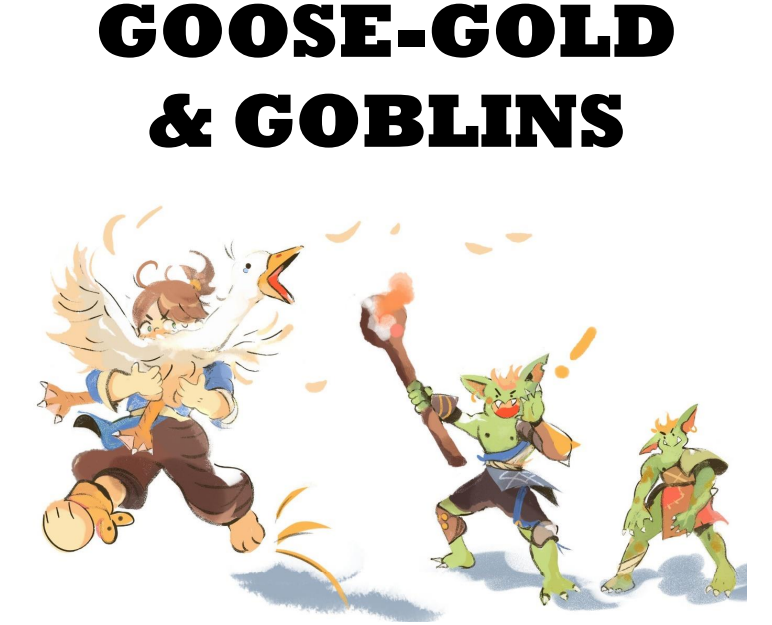
Goose-Gold & Goblins by Patrick Stewart is in my folder. I don't remember ever seeing this or downloading it or anything. But here it is. I opened it and the first pages are just plain text. Most of this is just plain text, I think. Sans the image I posted above. Starts off by letting us know the design goals:

A game you can play across generations.

Violence as a last resort

Challenge matters, threats are real

If in doubt, do it like BX

Use oral culture techniques

Avoid 3rd person, try to use ‘I’ and ‘We’

Geese are treasure

No weapons

Courtesy instead of Charisma

XP for Friends and Food

Pretty good list. Let's you know up front what you are NOT getting into. This will not be a game of dungeon-crawling and monster-slaying. This will be a fairytale type of game, possibly kid-friendly, definitely violence-averse. Cool.

So basically this is a game with a very specific setup. You and all the other players are from the same village or family and your mom is sick. Also, the goose is missing. This is bad because geese are super important and valuable. You must help your mom and get that goose back!

And if you resort to violence anywhere near a goose you're in big trouble because those bastards have a demonic berserker rage mode.

Interesting game concept. I don't know if Patrick developed it beyond this "proto-design" doc from 2020. Here's a blog post he made about it.

Oldskull Game Epansions I: Character Creation by Kent David Kelly is a big fat book of character creation optional rules, tables, and clarifications of existing rules for Old School Essentials, or really any B/X style game. It's got lots of ability score rolling methods, exceptional ability score rules, tables for appearance, alignment and deities, personality, skills, etc. The list goes on.

The book looks fine. It might suffer a little from over-production, IMHO. It has a slight tinge of that early desktop publishing era mania where you felt like you had to use all the buttons on the program. But maybe that's unfair of me. It does not have a garish watermark and the font is easy to read. So I'll back off that a bit. It looks fine. I just don't like the header and footer very much. Something about them is too busy for what the book is and is trying to do.

It has a lot of art, which seems to be a mix of public domain and clip art. And it's all good stuff. I think this is a nice little resource to have in your back pocket if you're gonna run some straight-up D&D type shit.


Sunday, November 12, 2023

Tool Talk

Digital drawing I like.
In 2009 I got my first pen tablet. It was a Wacom Bamboo, very small. I loved it so much I upgraded to a Wacom Intuos 4 medium tablet about a year later. I loved that one so much it's still on my desk right now, still in use, still working hard. What a god damn beautiful piece of equipment.

Anyway, prior to going digital I was deeply invested in my art tools. I obsessed over pens and brushes and brush pens and papers. In the 2000s I found that my favorite combination was a mechanical pencil (HB) + PITT brush pen + PITT or Micron .05 pen + Prismacolor markers + Paris Paper for Pens. This was the winning combo on which I drew all of my Pan-Gea art.

I went digital and found it to be so convenient and forgiving I just couldn't bring myself to draw on paper again for years. I mean YEARS. I had a brief period in the 2010s when I was drawing on paper quite a bit, doing stuff for Goodman Games and what-not (they had a no-digital art policy). After that, I switch back and forth but mostly drew digitally. The entirety of GOZR and about 50% of Black Pudding was created using my tablet.

But in late 2022 I suddenly started drawing on paper again. I can't even remember what happened to

Snot slug with Pentel brush.

make me switch. But since then, probably 95% of my art has been done traditionally. Almost all of the art I've created for ZSF (my space fantasy game) is on paper.

In the past week or two I've been sorting all my tools. I have a LOT OF TOOLS. Like, copious numbers of markers, pens, and brush pens. Nibs and brushes. Inks and papers. Some of these had to go away because they were dried out. But others were fine, some just needed a little TLC.

The tools on my desk right now that I'm favoring:

Pentel Pocket Brush Pen

PITT Brush Pens

Sailor Profit Brush Pen

And I just revitalized an old fountain pen by Sensa and it has a deliciously smooth line... but it is unreliable as hell. In fact... it stopped working entirely and I can't seem to fix the damn thing.

I picked up a Kuratake brush pen (#50) and it's a dream too. Though, honestly, the line quality isn't any better than the much less expensive Pentel. The main difference is the Kuratake can take an ink converter so you don't have to rely on disposable refills. And it has a metal tube, which feels good.

Kuretake #50 brush pen (not my art or pic).

But I really do love that Sailor Profit brush pen's feel. Though it is a plastic tube, it has the shape and thickness that feels best in my hand. The only issue I have with that one is that the brush tip itself isn't as fine and precise as the Pentel or the Kuratake. It's very strange how much variation there is between these common brush pens, even though, speaking honestly, you can't go wrong with any of them.

Sailor Profit brush pen feels very nice.

In my opinion, if you are interested in trying a brush pen, you absolutely cannot go wrong with a Pentel Pocket Brush. They are very inexpensive and have wonderful tips. However, keep in mind that the Pentel does not take an ink converter. What this means is you'll have to rely on the Pentel ink cartridges.

But there are workarounds. You can refill those empty cartridges using a syringe. There is also a cool tutorial you can find that teaches you how to modify an ink converter to fit into a Pentel body, so you can just use that instead.

An ink converter is just a refillable ink cartridge. Typically you twist the top to suck up ink into the cartridge so you can put it into your pen or brush pen.

A very popular ink converter from Platinum.


Sunday, December 18, 2022

GOZR on Save For Half

The fine halflings at Save for Half (my favorite podcast) have taken a look at GOZR! I haven't listened yet, but you should definitely listen immediately!


Sunday, July 17, 2022

I Married My RPG Folder But it Ain't Working Out

God damn, I haven't done a non-review since last October!

Let's look at some PDFs I have lying around cluttering up my desk and gathering dusk. I'll just reach out blindly and grab one or two...


So You Want to Be an Adventurer? is a wee little PDF of a mere 19 pages (including a solid black page) by Jared Sinclair with wonderful art by Evlyn Moreau. I cheated a little on this one because I picked it up today, so it wasn't gathering dust on my digital desk.

Usually in these non-reviews I don't read the game ahead of time. Usually I'm just looking at them for the first or second time and giving my off-the-cuff thoughts as I go. But this is a swift read. It's really just a conflict resolution mechanic, some simple rules for making a character, and a bunch of pages of cool pictures with TONS of blank white space to write in.

Character creation is writing down a certain number of things about your character (not an arbitrary number of things, but certain things). No stats or numbers are involved, it's all imagination.

The mechanic is to roll 2d6 and try to get 8 or better.

If you have a thing that benefits you, add 1 to the roll. If you have a thing that hinders you, subtract 1. Stack these up appropriately. For example: I have the high ground and a badass axe so I get +2 on my roll to fucking kill you. Or... I have a janky leg from a fall so I have -1 to jump that ravine. Etc.

Um... that's it. That's the game.

This is definitely a minimalist game. And there isn't much to say about it as a "system". Of course this game will work. You'd be hard-pressed to find a more heavily playtested mechanic than roll 2d6 and beat a target. The target of 8 means you effectively have a 50% chance of doing anything (not exactly, it's actually slightly less but who cares?). So the real meat of play probably comes from really using those advantages and disadvantages, narratively. Which is very cool.

There are a million games like this you can find at any moment. And of course that's to be expected. This type of system is kind of bedrock to the entire hobby. This is just a "here's a way to resolve things, now GO" sort of project. With most of the space left over for you to write new rules and ideas. I believe there are people who might pick this up and go "What the actual FUCK did I just pay for?" because let's face it... you can slap this together on your own in a hot 15 minutes and do your thing (but it won't be as awesome without Evlyn's art). There is nothing new here, nor is it claiming otherwise. But some folks will feel a little cheated, I fear.

Maybe this just appeals to some other types of folks (myself being one of them to a large degree)... this is a book that invites you to come and play and be creative. It wants you to make shit up. It wants you to enter the imagination zone. This is a "game" that reminds me of what I invented as a 14 year old who had only experienced RPGs one time and didn't own any. I made shit up. It was magic.

As a lover of ideas and tools for making shit up, I approve.


Wastoid: An RPG by Jason Tocci.

34 pages, based on Knave by Ben Milton, and inspired by Fallout. With very cool art. The layout is clean and simple and certain headers and stuff do remind me of the Fallout game aesthetic (though I never played it, my kid played the shit out of it).

In an interesting twist, character creation doesn't come until halfway through the book. Bold move, Tocci.

I like the use of "game moderator" instead of "game master". You get to keep the GM term that is so ubiquitous but you ditch the "master" part that seems to bother some folks. Very nice. But I'll still use Judge nonetheless.

There's a nod to Jim Wampler's Scientific Barbarian zine. Very nice.

On the "playing the game" page, there are three important aspects of game play described. One is to set boundaries, such as "let's not have rape, ok?". I have no idea why this type of suggestion triggers some folks. The very idea of DISCUSSING things ahead of play is somehow alien? Like... I get it... when I was gaming back as a teen we didn't discuss jack or shit before playing. And we had some monumentally FUCKED UP experiences that probably would have been smoother and more fun if we'd just... y'know... talked about it.

Another one is to telegraph intent, as a player. So instead of saying "what's in this room?" you say "I stand in the doorway and casually scan the room. What are some things I can see?" This is very nice because it shares some of the labor more equally. So often in games, the players really do shove everything off on the GM.

I'm not super familiar with Knave, so I don't know how closely this game cleaves to it. I can see that it is largely OSR-friendly with d20 rolls, 2d6 reactions, and so forth. Seems straightforward.

The initiative system is the same as what I used in GOZR, which is the same as Mörk Borg, which is the same as Knave, and I have no idea where that method originated. But it works and I like it.

Cool stuff about junk. You gather junk (because in the post-apoc hellscape everything is junk) and you can "spend" it to repair weapons and armor. Very cool. And probably a nod to the computer games? I dunno. But I like. Roll 1d6. On 1-3, enemies go first.

Yeah, this is sweet. You got stunts, rads, and mutations. If you are into post-apoc, you'll probably dig it.

Sunday, October 3, 2021

I Shot My RPG Folder

I haven't done any blind reviews in a while. Owing to my lack of focus, let's do this random ass shit. As always, I often do not know who the fuck makes these games so if you dislike any of the creators that's just on you, man.


I really have never heard of A.C. : After Collapse by Justin Oldham published by Shadow Fusion. I'm honestly not sure how I got this. Maybe a bundle? No shade to Shadow Fusion, but I would never buy a game like this. Even though I loved The Road Warrior and made my own post-apoc RPG called "Surivors" based on it when I was 15, I am just not into the militant post-apoc jam.

So this game says it is a d20-based system, classless, with detailed combat rules and rules about radiation, etc. Interesting thing: it says that there are three classes of RPGs in the Collapse timeline. There's B.C. (Before), D.C. (During), and of course A.C. (After). So you can play games I suppose in modern times while the world is still humming along and during the tumultuous collapse and then after it.

Shit, this is from 2019? That's pretty recent.

So my first impression is that this is too big and not my bag. It's 286 pages... about 200 pages more than I need or want, generally. But that's just me.

Oh no... there's Upper Body Strength and Lower Body Strength and there's an Attractiveness stat. And damn, the section on batteries takes up half a page of the table of contents! Batteries must be a big fuckin' deal.

The Collapse seems to be brought about by AI, perhaps inspired by Terminator? There's a bit about homeowners gating their communities and trying to ignore what was happening in the world around them. Seems familiar.

Ultimately, a game with an "Upper Body Damage Modifier" is just not going to be my taste. If you like crunchy systems and if you're into something like Twilight 2000 maybe this is your jam.

Way back in the old days, Palladium had the license to do Teenage Mutant Ninja Turtles RPG stuff. The original After the Bomb was a supplement for TMNT and Other Strangeness. I suppose since that license has probably lapsed, Palladium just made a whole separate After the Bomb RPG.

I picked up this book recently because I kinda dig funny animal RPG shit and I already owned several of the related supplements.

There's a weird disclaimer right at the front where Palladium says they do not condone the practice of magic, among other things. As if this game was gonna find it's way into the hands of little kids whose parents are Bible thumpers. This is 2021... Tik Tok exists. After the Bomb is really no threat, guys.

Looks like Erick Wujcik based this entirely on the house system. Cool. I don't have much to say here... I like that this exists.


Ok, I picked another monster of a book. This sumbich is 350 pages! Ehdrigohr, a game with precisely the right number of hs in its title, is by Allen Turner, published by Council of Fools, and is powered by Fate. Now, I'm not the biggest Fate guy. Which is weird because I mail ordered a copy of FUDGE back in the 90s and loved it. But I guess if I'm gonna do a FUDGE then I'll just do a FUDGE. No shade on Fate, I know a lot of folks who dig it.

Oh shit is that Papyrus font? Bold.

So the premise is that nine tribes of people dwell in a broken world of darkness where they struggle to maintain the light. There are chaos monsters or something roaming the land. You play someone who probably wants to keep the monsters at bay and protect reality. Cool.

I am not a big fan of the graphic design. It smacks too much of the high desktop publishing era. There's a border around each page and a lot of use of watermarks. We don't see any spot art until page 27. But I do like that that aesthetic is kind of Native American or Mesoamerican... I know next to nothing about this, so I'm not even sure what terms to use. But clearly from the art and some of the language of the book it is in this vein.

Though the art is kind of scant, it is pretty cool. Not all of it is my vibe but I dig it. I just wish they hadn't let the watermarks bleed through the art. Again... smacks of "I CAN do this so I WILL do this" desktop publishing. Just a pet peeve.

Ok. This looks like a true labor of love and I'm not gonna poo-poo it. There's a lot of worldbuilding in this thing. It's BIG. For me, it's just too damn much and I'm just not into Fate. But if you like Fate and you like the aesthetic then by all means dig in and see what's here.

Saturday, September 18, 2021

Back to BasiX Hardback

I joined the Kickstarter for the Back to BasiX issues 1-10 hardback collection and I got my book yesterday.

I remember this fanzine coming out a few years ago and I was super impressed by the great cover art by Matthew Ray. It's nice to see this collection includes all of Matthew's covers plus a new one for the main book cover.

I didn't pick this zine up or read it before now. I MIGHT have it in PDF and just never got around to looking at it?

Anyway, it's a very nice looking book. The cover is hard and heavy and the whole book feels weighty and substantial in your hand. This is probably because the paper stock is decent and it's on glossy paper... kind of like a glossy magazine but heavier.

The binding is glue, so that's a downside. I feel like some of these pages are eventually going to come loose. Plus it means the book doesn't lay open. It wants to close when you open it up. Not a huge downside - I'm just spoiled by all these mega deluxe boutique hardbacks I've seen over the years. Still, even really nice, solid hardbacks don't always lay open flat. Old School Essentials Rules Tome is very nice and sewn-bound but it won't lay open, generally.

The title on the spine is not aligned so it's hovering close to the bottom edge. I suspect either a mistake in layout of in printing. Of course, duh. But it's really not a big deal unless you are super OCD about that stuff. Which is fine.

The layout is uber-basic and Thom Wilson, the publisher and author, uses the classic B/X Souvenir font (or perhaps Soutane, a similar knock-off?). This two-column look is immediately nostalgic. I do like that quite a bit in a "let's watch Andy Griffith" sort of way. But the full justification of the paragraphs is a bit jarring - not much use of kearning or adjusting the space between words. A bit awkward, which is kind of lovely in fact. I'm kind of a fan.


I also noticed some typos and other errors. I see that a lot in small press books. Again... I'm not going rag on that. These are labors of love and I am here for it. Editors and layout geeks may cringe but if they love old school gaming and small press publishing they also gotta smile.

Of course none of that matters if the content is no good. In this case that's not a problem. Again, if you're into old school RPGs and B/X D&D in particular, this is a tasty dish of yummy. Each of these short 10 issues is chock full of adventures, monsters, NPCs, magic items, spells, maps! And an interview in each issue with some old guard of the hobby.

And it is a zine. Like... proper zine. It has ads and want ads and product spotlights.

Here's my takeaway: If you like B/X D&D, you will enjoy this book and you will get some use out of it. There are plenty of little adventures to run in here and lots of simple new magic stuff to play with. If you like small press TTRPG books you will dig this. It's got a lot of cool bits.

So don't let any of my criticisms of the physical book or layout deter you. I do kind of adore this book. I honestly wouldn't want it to be any other way! This is in my wheelhouse.

Wednesday, June 16, 2021

The RPG Folder from Heck

It is once again time to crack open that folder of unsorted RPGs, randomly select a few, and dash out some thoughts about them. Just like in the days of old.


AGON by John Harper is a game about poor Greek bastards serving the gods in an endless divine war. This game looks pretty focused and themed. The layout is landscape, everything looks pretty good. It's one of those games that takes its time but doesn't seem to meander. We don't get an intro until page 8. It's a game unafraid to give you multiple pages of pictures and quotes to prime the pump.

So right off the bat the game sets up a clear purpose for the game - heroes (players) must gain glory by winning fights and contests. They must also carry out the quests given them by the gods. Players are explicitly in competition with each other and the GM (the Antagonist), trying to out-awesome each other. But also they are part of a team working toward the goals of a god so they must work together. That seems like a nice tension.

The mechanics are elegant. You have stats ranked by dice. Bigger dice = better stat. When you have a contest, you roll some dice. Whoever has the die with the biggest result wins that contest. I like it. Seems like a quick way to resolve conflicts and is well-suited to playing in person at a table. Makes me want to revisit ideas for dice pool systems.

So the whole thing takes place in a fictionalized ancient Greece with gods and monsters where strong heroes duke it out or have fantastic contests of a - shall we say - Olympic quality.

I would play this.

Side note: I recognized the name John Harper because you can't toss a stone in the RPG sphere without running into Blades in the Dark, another game of Harper's design. This guy is good. Watch out for him.


Repatriated by M.A. Guax is a pamphlet game, so it is minimal in nature. The Basic Rules are 2 pages.

It says it is a game about being exiled to a forbidden land that belonged to your ancestors and that you have some kind of divine right to claim it. There isn't much here in terms of explanation or guidance. There's no discussion of how to create such a setting or what you're supposed to do in it.

The rest of the game is rules for survival and task resolution.

There's also a separate equipment pamphlet.

This is a weird one. The design seems fine. You have a few attributes and some vulnerabilities: Hunger, Pain, and Stress. All dice rolls are 2d6 vs. your vulnerability.

The game isn't listed on the creator's page as far as I can tell so I honestly don't know how I got it. Maybe it was up for a time but taken down? I don't know the history of it.


Fireball by Łukasz Kołodziej is "An Old-fashioned Role-Playing Game" published under a Creative Commons license. This game appears to be a basic fantasy adventure game covering similar ground as D&D. It only uses d6s.

When you create characters you roll some d6s and your lowest result determines your species while  your highest roll determines your character class. Each roll is placed on an attribute such as Strength or Agility.

There's a neat little quest generator where you roll some d6s and you can get stuff like "go to a dark forest that has been attacked by trolls to repair a stolen strange machine". Kinda cool. I really dig random generators.

When you have a conflict, you decide what the stakes are. You can say some health will be lost or an item will be lost, etc. Then each side of the conflict rolls 1d6 and adds their attribute and skill. The lower roll suffers the predetermined consequences. Interesting, deciding stakes before rolling and not just assuming each conflict will be about killing each other.

The game is super simple and intended for fast play. To give you an idea of how simple, the wizard has 3 spells. Oh yeah... it's also free.

Sunday, May 30, 2021

Review: Black Pudding #5

Here's a nice review of Black Pudding #5 by Matthew Pook. Thanks, Pookie!

Has it been THAT LONG since #5? There's a #6 out there too and I'm "working on" #7. Each issue is taking longer to produce because my interests are drifting elsewhere. But I still love the zine and have no intention of putting it to rest yet.


Friday, January 29, 2021

The RPG Folder I Caught in the Act

Part of this amazing ongoing series!

How it works: I randomly click on an RPG PDF, check it out, and maybe write a little mini-review. I usually write about it while I'm looking at it.


Oh snap! I clicked on an OD&D referee's screen. And it's a damn good one too. Trouble is I'm old and I don't remember who made it or where you can download the thing. Someone help me out in the comments. Don't hold out on me.

EDIT: StuRat in the comments came through with the link. This is from a blog called Smoldering Wizard. Check it.


Darkfast Dungeons by David Okum. Man I am such a wank. I love David Okum's paper minis and I follow his posts and Patreon. But I have never really looked at this book. SHAME ON ME.

So first of all, I'm a sucker for anything that emulates that classic TSR trade dress. If done well, it's just delicious to me. It can be stale, it can be overplayed. But anyone who says it is a dead art can suck it. This cover looks good.

Ok, so this appears to be a full game. Again, color me a dumbass because I didn't actually know that. I just thought Darkfast Dungeons was a series of paper minis.

I love that this is written and illustrated by David. I love ventures that are single-creator visions. Now, don't get me wrong here. Obviously there's nothing wrong with collaboration and group efforts. I'm just saying that I have a special place in my black heart for these kinds of singular vision projects.

This one appears to be compatible with or based on other games of David's. Interesting. It's definitely inspired by the classic 1981 D&D game. Natch.

Nice looking character sheet. Cool art, of course. I wanna play a Corvian.


Chronicles of the Spacejammer! by Richard Ruane is one that I just don't remember picking up at all. I might have snagged it on a bender* and never opened it. It's a book with 36 space-based backgrounds for Troika!, the other world's favorite RPG.

So this appears to be something that fits snuggly into Troika!'s aesthetic, which is kind of spacejamming to begin with. Just spot-oogling these I find the Chronomancer's Ex to be interesting. A person who hopped a ship with a chronomancer, ended up in a bad relationship, broke up, and is now kind of wayward in the stars perhaps trying to make their way back home.

Isn't that wonderful? This is the power of the game's backgrounds scheme. It's world building and character building all rolled into one. Not much more to say about this one. It's literally a book of 36 backgrounds. And they all seem pretty damn cool to me.


Legacy: Life Among the Ruins (2nd Edition)
by Minerva McJanda and Douglas Santana Mota. Hey it's only 55 pages! I might be able to say more about... oh no... that's just the handout document. The main game is 305 pages.

So this appears to be a post-apoc game, judging by the cover. It's a nice cover, I dig it. The art by Tithi Luadthong is pretty dope. Oh... hey. This is published by Modiphius? Huh.

Oh, ok. This is Powered by the Apocalypse. So the mechanics are gonna be similar to many other PbtA games such as Dungeon World. You know, to this day I don't actually know the rules for these games. I've read some bits and listened to a bunch of podcasts about them but I haven't quite grokked the concept entirely. Here's my uneducated idea of what they are: You have character abilities, called Moves, and you roll 2d6 when you want to use one. If it's like 4+, you did it. Or something. I know it's not that simple. There's a range in the middle that is "yes, but". I dig it.

Anyway... the game has a decent look. I don't love it. I think the artist is pretty rad and lots of the art is killer but a lot of the art in this book has the look of photo-manipulation - which is not my cup of tea. It's a turn off for me. But it does capture the post-apoc future world vibe so maybe you'll love it.


Colours of Melestrua: Ragnar's Keep by Ian Brockbank is a setting for RPG adventures in a working medieval castle. So this guy's name is Ian and he says "games master"... I'm betting this is a British publication. I'm so smart. I guess the spelling of "colour" didn't give it away. I love the Brits!

This is what it says on the tin. It's a very detailed castle with lots of rooms, all of which are described. There are some drawings of the castle and maps for each level plus the cliffs and river around it. There are detailed descriptions of the castles' important occupants plus their 5th edition stats. Overall, it appears to have everything you'd need if you are into historically accurate medieval gaming. Which, of course, I am not. So I am a terrible judge of this book.

The trade dress is nice because, I think, it is an aesthetic callback to old RPG resource books such as Harn and Role Aids and others. I'm probably wrong on that, but it strikes me that way. Actually, now that I think about it, this reminds me of a 90s RPG resource book akin to ICE's Campaign Classics.

*Aside: I use "bender" casually to indicate some event where I spend all day making memes or listening to obscure 1982 metal albums. But it dawns on me as I type this that "bender" might be a term fairly exclusive to heavy drinking. I don't know. I don't mean heavy drinking, for the record. My heavy drinking consists of 2 tequila sunrises on a Saturday night.


Monday, December 14, 2020

The RPG Folder in Outer Space

Has it been 3 months since my last RPG folder post?? Yeah, I think so. Here's another batch of three RPGs I clicked on randomly (like, I close my eyes and move the mouse around and click a file. Hope there's nothing evil in here.

e-Adventure Tiles: Swamps by Edward Bourelle is exactly what the title says it is. A packet of something like 16 1" gridded swamp tiles. Print, trim, put minifigs on 'em. They look pretty good. I have almost no experience with this style of gaming but when I was using a battle mat I understood the value in having a precise map. For certain types of games.


Kingscairn: a Troika! Zine by Uyuxo Games with lots of public domain art by William Thomas Horton is a Troika! zine.

The zine gives you some random tables, six new backgrounds, and a few locations.

Right off the bat it's good to go because it uses a d20 table, shattering the d6 aesthetic of Troika!. I dig it. Fuck the system, right?

Holidays, guilds, random names, backgrounds. The locations include some random encounters and descriptions.

Overall, this looks like a very quick and dirty little setting you can just sort of run with. No fuss.


What the actual fuck have I gotten myself into here? First of all, it's a Fate based game. And... y'know. That's great. I am just not very into that game. I talk about it here a little bit. Second, and more importantly, this motherfucker is 382 pages long. Now... I'm a gonna preemptively state that no game needs to be 382 pages, especially one based on a fairly loose, narrative-leaning system. But hey. That's my lazy ass.

Modernity is a game by someone. I have not found the author's name yet. It is a Creative Commons game, which is awesome. Props to them for making their vision something for everyone to use and enjoy. Looks like Glacier Peak Games did this.

Ok. I'm on page 11 and it looks like we're starting. So now I'm getting a feel for how you can get to 382 pages.

I rib, but y'know.

Art is part of the setting, and this one has a lot of CG style art. However I can't seem to find the name of the artist in the credits. The pieces are signed and I think it says "Dash Reed". But I Googled the name and came up empty. Dunno. The pieces are OK, but not my cup of tea.

The game is basically an X-Files kind of thing. Hidden world in plain sight. The book says this:

Modernity is a thriller setting where modern meets mystery, where fact
fights fiction, and where skepticism slams headlong into superstition.
The several billion denizens of an otherwise mundane Earth circa “right
now” share reality with tabloid headlines that can be revealed in all their
grisly truth by heroes who dare to uncover their secrets.
I do pick up a tone in the opening pages of the text proper. First paragraph mentions "frou-frou coffee" and "faux news". One of the three modes of play (Contemporary, Occult, Noir) says "for the hyperconnected, media-saturated, politically correct, information age that we all live in." So maybe the author here has a bit of an axe to grind. Dunno.

This is a fat book and obviously a lot of work went into it. But it's definitely not for me. Check it out if you like X-Files and conspiracy theory fringe types of games.


Sunday, October 25, 2020

Troika! RPG Review


PREAMBLE

Way back in the stone age days of G+, there was this weird game that fermented and grew in my peripheral view called Troika!. I ignored it. Not because it didn't look cool or whatever, it's just that it wasn't D&D and wasn't interesting to me at that time. The guy who made it, Daniel Sell, was also a peripheral figure in my view. I had read and been greatly inspired by Daniel's blog post "How to be an adventurer" on his blog What Would Conan Do. But my brain didn't connect those dots at the time.

The game was also associated with Jeremy Duncan, another figure looming in the periphery of my brain but who I just didn't know much about. Turns out he drew most of the original weird art for it.

Soon Troika! seemed to be the talk of the town. There was a Kickstarter. There was something about a "Numinous" edition. G+ died somewhere in that time zone and I'm honestly not sure which event came first. At some point I finally got a copy of the game and read it and was quite inspired. It's a damn fine game, and I'm going to talk a little bit about it here.

THE GAME

Troika! is a hack of Advanced Fighting Fantasy, a popular British RPG that originated as a choose-your-own kind of adventure book series. I'm not sure the author likes referring to it that way or not as I'm not terribly involved (like... not at all) in Troika! comings-and-goings. In a guest post at the blog Thoul's Paradise, Daniel said this:

"Troika is the inevitable hospice of a tired mind."

And this:

"It was built as a strongly worded objection to the vogue of transparency and usefulness. It still holds immediacy, since anyone can play the game in a matter of hours if they want. They just need to go limp and enjoy a state of comfortable confusion. The book doesn’t need to tell people that it expects them to decide what is happening for themselves since it offers few answers and the answers present are contradictory."

So it seems the author is not a fan of clarifying the intent of his game. Not only do I respect this, I admire it.

The game is a bit like this:

You have a Skill score and some Advanced Skills that represent what you are good at or about.

There are two types of rolls.

Roll Under means roll 2d6, trying to get under your Skill + Advanced Skill.

Roll Vs. means rolling 2d6 + Skill + Advanced Skill vs. an opposing similar roll, probably made by the GM.

For combat, you have Stamina. This functions like hit points. When it runs out you are dead.

Initiative in combat is determined by pulling stones from a sack or cards from a deck or something similar. I used the Troika! initiative cards, which I highly recommend. You put x number of cards in the stack for enemies and each PC gets 2 cards. You draw out a card and that person goes next. There is an end of round card that is mixed in as well.

There is a Luck score. You can spend Luck only for a couple of benefits, including extra damage on a hit. You can also make Roll Under Luck rolls, which are kind of like D&D's saving throws. So, as in DCC RPG, when you spend Luck you run the risk of being out of Luck when you have to make that fateful Roll Under Luck test.

Over time, you get to roll 2d6 vs. your various Advanced Skills, trying to roll OVER them. If you do, you get to improve them by 1. This is how you advance and learn new skills. But advancement isn't a big concern with this game. I don't think the game is meant to play in "campaign mode".

Casting spells costs Stamina points. Your wizard will become quite weak and fatigued if you try to blast everything around you all the time like Tim the Enchanter.

For character creation, you roll on a d66 table (36 results) to see which background you get. Each background is like a little evocative description of a character at one place in time. You get a little flavor text, some skills, and some items. From there you can mold the character in any way you wish. The backgrounds ARE the setting for Troika!.

Ok, that's pretty much it.


THINGS I LOVE

d66 tables: Love 'em. I've adopted their use in other projects I've been working on. While Troika! is not the first time I saw a d66 table, it is definitely the game that made them loom large in my mind. I also started using d44 and d88 tables as well.

Backgrounds: Love 'em. So much flavor and world-building can be stuffed into these simple little portraits. You can, and should, write d66 background tables AS SETTINGS. I've written two of them myself. It's god damn fun.

Damage tables: Love 'em. They allow you to have a pretty wide variety of weapon damage only using 1d6 per damage roll. It's a nice visual artifact too. You could add a secondary 1d6 table to your weapon for weird FX. Like if it's a strange esoteric device maybe it sometimes zaps, sometimes burns, sometimes freezes. Interesting idea. See how this game inspires?

Inventory system: Love it. I am absolutely stealing it for my own games from now on. If you want that hand grenade handy, put it at the top of your list.

Spells: Love 'em. Very simple and direct. We don't need to know about how many cubic meters a wizard can burn. We just need the broad strokes.

Monsters' miens: Love it. Like a mini reaction roll table tailored to each critter.

Initiative stack: Love it. Quick and dirty and doesn't get in the way. Initiative systems always irritate me because they slow things down. This one does not slow things down. But see below.

The actual physical book: AWESOME. If you don't have a copy of the hardback Numinous Edition, GET IT. Lovely little tome that feels good in your hands and has delicious art by Jeremy Duncan, Dirk Detweiler Leichty, Sam Mameli, and Andrew Walter.


THINGS I DON'T LOVE

Initiative stack: I LOVE the concept and it plays fast. But it has mixed results. It can lead to long stretches where one player is unable to act at all. Which leads to kind of ridiculous results... Mid-combat, you are literally in the face of the enemy but somehow 4 other PCs and 6 other enemies take actions before you. I know this is a GM fiat thing. In that situation, the GM should just let the player go next. But that means ignoring the initiative rules, which invites the question "is this a good system or does it need work?". Players in my Troika! adventures seemed to be on the fence about it.

Skill and Advanced Skill: The language is clumsy. It's straight from Fighting Fantasy, I believe, so this is carried over. But it would be easier in play if it was something like Level and Skills or Power and Skills. Skill and Skills = a bit of confusion.

Roll Under/Over: Similar to Skill/Advanced Skill, the fact that your core mechanics require you to roll under for some things and over for others is confusing at the table. It is very simple and easy to grok, I know. And it damn sure works. But over the years I've been running games this problem has always reared its head whether it's old school D&D or Troika!. Players who aren't familiar with the game and who probably won't school themselves on it will ALWAYS ask "Do I roll high or roll low on this one?". And it is annoying to have to answer it over and over. So I prefer game designs that don't mix and match these mechanics.

OVERALL

I love the shit out of Troika!. It's a solid, fun game that plays fast and loose. It is endlessly hackable and inspiring. I'm all about inspiration, so I tend to gush about this game. It captured my imagination in a way that very few games ever could. So far I have published two books based on the game and plan to do more.

Sunday, August 23, 2020

An RPG Folder You Once Smooched

Another chapter in this unfolding story.

How this works, for the record: I open random PDFs (I usually close my eyes and click) in my gaming folders and I snip the title, then I give a very quick, short, off the cuff response to what I see. Usually this means I haven't read the thing completely if at all. Sometimes I dive deeper, sometimes I just say a sentence or two.

So here goes another batch.

Paragon: Universal Role-Playing Game by Sean Boyle. Right off the bat, the title isn't going to grab me. But this is only because a) I'm not a huge fan of superhero games and b) I'm not a huge fan of universal systems. Those are my biases going in.

Not that this is a supers game. It's universal. But that cover art by Adrian Reece (which is a bit too early-age digital for me) screams SUPERS.

Um... you need d4, d6, d8, d10, and d12. So no d20 on this bad boy. Plus you need a deck of Paragon cards. A PDF of the cards comes with the game so you can print them out. They're simple black line art so that's no biggie. The cards are like special effects, such as Lucky Break. That type stuff.

Oh man... there are 13 stats for a character. There's a max load table (lifting I guess?) with decimals. So those are not giving me a warm and fuzzy. There's a list of backgrounds and weaknesses, which feel like GURPS-style Adv/Disad. Which is totally fine, of course. It's an intuitive concept and I don't know why people shit on it sometimes.

There's a beefy list of mental disorders, which is a huge callback to classic RPGs that tried to model everything. And this game is definitely in that lineage. It wants to simulate everything it can so you can play any genre you like. Of course, from a game design nerd perspective, this is a fool's errand and no one should endeavor to do it. What you usually end up with is a textbookish set of all-things-being-equal rules that might fit well in an empty white playing space but is clunky and uninspiring when you try to use it in a genre or in a very person setting.

Not poo-pooing this game at all. It's a fleshed out labor of love. But generic systems are just not inspiring to me anymore and I don't believe they accomplish the task they want to accomplish, in the end. At least not for anyone other than the game designer and those few people who for some reason love the blank white space of such a game.

Hypertellurians by Frank "Mottokrosh" Reding is a sci-fantasy RPG... and I really really love me some sci-fantasy. It is a Creative Commons game, which is rad because you can make your own Hypertellurians content and put it out to the world.

The text says it is compatible (more or less) with most old or new adventure games. I'm not sure what that means since game mechanics are pretty disparate between games. But it does look like the game has six character classes or types, so maybe it's got some strong D&D DNA in it?

The text says that the rules use "natural language" so there's lots of room for interpretation, which is good. But also I can see that the characters have numbers rating stats. So it's a mix.

A big portion of the charsheet is inventory slots. One of the key principles of the game is that what you carry defines you. This is certainly a strong callback to old school D&D in which the thing that differentiates two level 1 fighters is that one has a club and the other has plate mail and a sword. Big difference. Also, games like Knave and Into the Odd certainly put a high premium on inventory. I'm also doing this to some degree in GOZR. Anyway, I like it.

I just flipped through and saw a power called Magnificent Mucus Membrane. That's a winner.

The game's art is a mix of custom art and what I think are old public domain sci-fi pieces that kick a lot of ass. The cover by Anna Katariana Molla is pretty sharp. I snagged a print copy of the game and it looks not too shabby. It's on the edge of being a little bit too desktop publishing for my taste, but it's pulled back just enough to be good.

The character sheet is fantastic. It's drawn, and there's a painted version. I can't see who the artist is, though. I might be stupid. But there is a Skullfungus version too! And we all love some Skullfungus.

In the Heart of the Sea by Goblin's Henchman is a one page dungeon. Or more accurately, it is a one page seafaring hexcrawl procedurual thingie. It's only one page. Henchie gives us three "hex flowers", which are big hexes with 19 smaller hexes inside. Each day you roll 2d6 and use the navigation directions hex flower to see which hex you end up in. Each hex has some kind of encounter or trouble or other event. It looks like a very simple, fast way to determine sea travel events if you end up on the high seas in a hexcrawl kind of campain. I'm gonna say neato!

Wednesday, August 5, 2020

The RPG Folder from the Pits of Tartarus

A continuation of this erudite series.

Hack: the RPG is an RPG hack written by Eric Bloat, lifted from his zine Valor Knights. It is basically an amalgam of The Black Hack and The Blackest of Deaths.

Eric's idea here is to provide a really basic, loose, fast RPG framework from which you can hack your own games, worlds, and adventures.

The core mechanic of this game is to roll 1d20 vs. a target number. At the same time, roll 1d6. If the d6 is a 1, there is a Hindrance. If it is a 6, there is a Benefit. It's an elegant way to establish a non-binary resolution mechanic that isn't too fussy. Most of the time that d6 is ignored because it'll be 2-5. And hey... if that bugs you, then you can create your own house rules for what 2-5 means. Right?


In Darkest Warrens by Scott Malthouse is a "minimalist fantasy RPG". It lives up to the title.

In the most basic sense, this is D&D with massively simplified rules. It uses totally different names for stats and things but it's the same basic concept. You have attributes, classes, and levels. Everything is resolved by a 1d6 roll. The game is 5 pages long and includes all the rules, advanced rules, magic, monsters, an adventure, and a setting. And it has really great art plus a map by Dyson Logos, no less.


Metahumans Rising is a superhero RPG by T. Dave Silva.

I literally have never looked at this or head of it. I clicked it open and I have to point out that the first thing I see is the PDF contents tab showing me the word "offensive" twice in a row as the first two items listed. This is a link to page 61 of the PDF describing boons or something related to offensive powers. Funny little editing snafoo I guess.

First impressions are that this is a labor of love. It starts with a memorial to St. Julian Perkins Jr, R.I.P., who was one of the game's playtesters. Very nice to see this right up front. It shows that this is truly someone's love project.

Ok, so the text formatting is not good. Lots of gaps between words on the memorial page. Perhaps that was just a last minute addition and didn't benefit from a second pass. Dunno.

The chapter headers are not attractive. They remind me of cheap desktop publishing. I would prefer to see this simply with big bold words instead of the generic header images. But I'm being mean about the aesthetics.

Lines and Veils... is a great idea. I don't know if it is original to this game or not, but I dig it and I'm happy to see it here. Basically players decide at the start what are the Lines and what are the Veils. And I'm guessing these can be updated. A Line is something that does not happen in the game. So I'm guessing maybe a player might say that any depiction of rape or child murder is a Line. You don't cross the line. A Veil is softer... it's something that can be referred to, but not "shown". Like... the villain Mad Mad Daddy might have blown up an orphanage, killing a bunch of kids. But this isn't experienced at the table, just referred to. This is a great rule to have right up front.

Ok, so this is a fairly detailed, dense game. I can see by skimming it that there are ample examples of character creation and design of setting. It's a game that seems to encourage you to create the comic book universe you want to create. Lots of stuff related to the various ages of comics, and so on. What I'm not seeing much of is game mechanics. The crunchy dice rolling bits don't seem to be mentioned until page 80+, and even then I don't readily see how it works. Not necessarily a gripe, I just haven't invested the time and energy into reading all of it.

The art is not bad. My overall impression is that this is a heartfelt supers game with a lot of love put into it. I feel like it's a bit bloated and the organization isn't entirely intuitive to me. But that's me. If you're looking for a supers RPG I believe you should give this one a look see.


Saturday, August 1, 2020

The RPG Folder That Killed Hitler

A stalwart continuation of this series.


The B/X Rogue: Before he was occupied with producing the best version of B/X since the original, Gavin Norman published a series of cool books for use with B/X and Labyrinth Lord. This one is a character class - the Rogue - that basically fixes the old Thief. We've all taken stabs at doing this. I did it in Black Pudding and on my blog and probably on a napkin somewhere. You can tell when a class is fundamentally broken: everyone almost to the person attempts to fix it. Let's face it... how often did you try to fix the Fighter? Not as often, I'd wager.

Anyway... Gavin succeeds here. You get a robust B/X style class full of all the goodies that thieves and rogues are known for. You get options. You don't suck at things. Gavin avoids the trap of those pathetic low percentile skills by taking a different approach. You have a certain number of "talents" and you can pick from a list of over 30. Each level you gain a few more. And instead of having an ever-increasing skill rank, you can do your talents pretty much at a high level of skill from level 1. For example, climbing a difficult surface requires a Dex check... and most Rogues will have a decent Dex score so you're going to succeed a lot. If the surface is easier... no roll required.

You can select from picking locks, reading scrolls, deciphering languages, bashing people over the skull, fancy fighting, and loads of others.

Good stuff.


Operators is by Kyle Simons. It appears to be a Fate-based game from 2018 focused on, I guess, military ops. Not at all my cup of tea. But this RPG Folder Project is not about focusing on games I like, it's about randomly opening files and looking at them.

I won't say much about this one. There are lots of photos of military type stuff. I'm not a fan of that, generally, and I'm also not a huge fan of Fate. But I want to stress that I'm not opposed to either of these things - just not attracted. I don't even know why I have this... unless it was part of a charity bundle, maybe? The book appears to be competently composed and I'm sure it's a lovely game to play. No criticisms from me, just not my bag.

I did note that it was part of The Gauntlet community and I enjoy their Fear of a Black Dragon Podcast quite a bit. So that's cool.

The League of Seekers by J. Lasarde (and others) is an RPG about... something. What is it about? I only just opened the PDF and read the first text I came to, which seems to be a kind of intro. But it doesn't actually say anything about what I'm reading. It tells me this is a TTRP and that is has something to do with history. It's basically a disclaimer stating that if some history is missing, that's not a big deal. This is fiction, after all. And it has no political message. Ok, fine, but what is this?

The art so far is super cool and creepy. So this is a game about monsters? The table of contents reveals some thematic stuff. History, Vampyrs from the East, Seekers.

So at this point I'm thinking in this game you play the role of a Seeker. But what is a Seeker? I would expect to see a clear description or some kind of clear signal as to what a Seeker is, at least in the next few pages.

There's a badass Cthulhu-esque drawing... then we get into Histories. And these are little paragraphs on a timeline, starting with a 730 CE (AD in the book) event near Damascus. Nothing about a Seeker. You gotta read?? This is a timeline... I gotta read this to know the game? Hmm.

Ok, 8 pages of timeline then a really badass art page of maybe souls looking through a door? Then we get our Introduction... and it's more prose and a paragraph about percentile dice. Then we immediately go into the game's resolution mechanics. Then a supremely awesome Cthulhu drawing. Then our Genesis chapter, which I think is chargen.

More prose. Then something about 18th century social classes. Ok, so this is where you decide which class you come from. Ok. What am I? What is a Seeker? No definition. No clear statement on what a Seeker is or what I'm supposed to do in the game. Lots of atmosphere with the great art and lots of prose text which... admittedly... I detest. Not this prose in particular, but this sort of thing in RPGs in general. Not a fan at all. Call me basic.

The book then seems to dive head first into various life paths and other chargen stuff. Looks like you can be a Vampry. Cool. But what's a god damn Seeker? Piecing together clues from the text, I would hypothesize that Seekers are people who know about or suspect supernatural stuff and they seek it out. To destroy? To catalog? Not sure. Let's do an experiment. I'll ctrl+F and look for "Seeker" from page one and see what I can see.

Ok... on the Contents page I can see that Seekers are reborn as "avengers" defending the people. So maybe Seekers are like reconnaissance super heroes. I'm now thinking League of Extraordinary Gentlemen. Maybe.

League of Seekers is formed in Paris, 1699. So that tells me a starting point. And I see that Seekers are sent to hunt monsters and map dungeons. So the picture emerging to me now is pre-Victorian clerics going on dungeon dives. Maybe.

The game book layout is ok. It's a bit 90s desktop publishing to me, perhaps in the Vampire-era aesthetic. Not my cup of tea, so I'm not a fair judge. I just know that it didn't grab me. The art is really cool, though. I really do like that.

But this game meanders and it's organization is confusing and baffling. This game tells you that you are a Seeker in a TTRPG but doesn't tell you what that means. It either wants you to do a lot of work to figure it out or it never actually reveals it to you in concrete terms. I think this is a serious problem that could easily be solved. That initial intro page, the one claiming no political agenda... that's a perfect spot to have a clear, concise sentence or two spelling out in no uncertain terms what the game is about and what a Seeker actually is. Because the awesome art alone doesn't tell you this and the prose is going to be skimmed or skipped by half the people who find the game, I promise.


Huh, this installment felt a bit negative. Sorry about that. I'm trying to be as honest as possible. I never want to be a dick so I want to qualify that my aesthetic taste is my own and if your game doesn't suit me aesthetically, that's not on you. I try to make that very clear. But there are some criticisms that are more objective in nature and I will call those out as I see them.

YMMV.