

Monday, December 25, 2017
Gorgaro Will Eat All People
This is the gorgaro, a B/X D&D style monster. It's good at killing and eating people.


Wednesday, December 6, 2017
Labyrinth Lord Character Sheet: Iron Company
Did this for my friend Andy Solberg's Labyrinth Lord game.


Inktober Drawings Drop
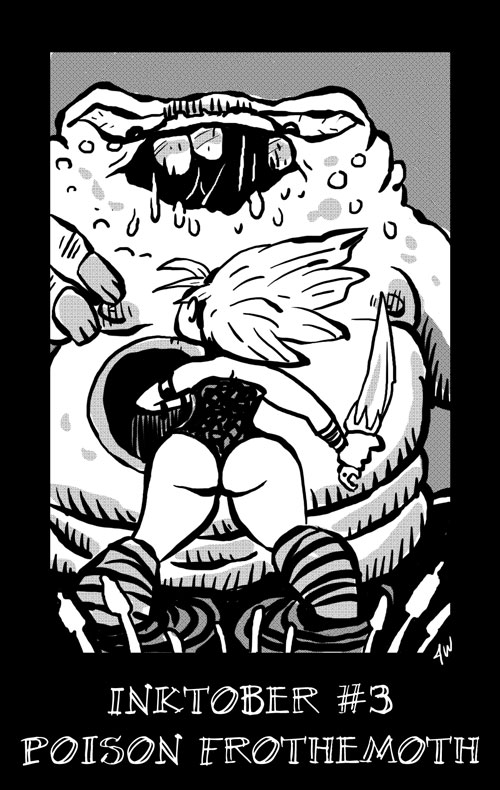
This year I did #inktober. Mostly. I didn't do the whole shebang. I just did it as I felt like it. Here's the whole bucket of wax:




Monday, October 23, 2017
Hoofnar the Barbullian!

The age of beasts, witches, and sorcerers! A time red in tooth and claw! Witness now, o traveler, these tales of daring deeds and hirsute heroics. Truly these are the days of furious four-fingered adventure!
Hoofnar is a comic character I've been thinking about for a few years. Probably posted about him before. I did this cover mock up in a moment of inspiration. Maybe this might lead to an actual comic book? I do love my funny animal comics.
NOTE: I actually have no memory of how I ended up with two distinct comic book character ideas that are reddish-skinned, horned adventurers. Zarp and Hoofnar are vastly different in tone, but have certain shared traits. In fact, all my Hoofnar art prior to this cover shows him with very red skin and I labelled him a "red bull". I moved to a brown skin here to distinguish him a little bit more from the skinny little devil character.
Saturday, October 7, 2017
Zarp
I've been thinking a lot about this little red guy. I started to say "red devil", but I never actually said he was a devil. In fact, none of the published comics every stated in any way what Zarp actually is. Nor does he comment on the matter, as far as I remember.
The character has always been a simple vehicle for telling stories. He's a guy who sees things and whose nature is to explore, wander, and - to some extent - comment on his world. I stopped doing Zarp stuff a long time ago but always wanted to come back.
Today I looked at the visuals and thought about the simplest element of this idea. What does Zarp look like? I found that my art has a wild range of quality on the subject. Some of my earliest Zarp drawings are just shit. Just complete shit. But others are really cool. The sheet pictured here shows the really cool Zarp images (just the heads) and it captures what this guy looks like. I added new doodles to make sure I knew what the hell I was doing when I draw him. Because one of my weaknesses as a cartoonist is that my forms meander too much. I don't define a character's look explicitly before I just start drawing, and that often leads to a visual drift that, in hindsight, is unfortunate.
I need more discipline.


The character has always been a simple vehicle for telling stories. He's a guy who sees things and whose nature is to explore, wander, and - to some extent - comment on his world. I stopped doing Zarp stuff a long time ago but always wanted to come back.
Today I looked at the visuals and thought about the simplest element of this idea. What does Zarp look like? I found that my art has a wild range of quality on the subject. Some of my earliest Zarp drawings are just shit. Just complete shit. But others are really cool. The sheet pictured here shows the really cool Zarp images (just the heads) and it captures what this guy looks like. I added new doodles to make sure I knew what the hell I was doing when I draw him. Because one of my weaknesses as a cartoonist is that my forms meander too much. I don't define a character's look explicitly before I just start drawing, and that often leads to a visual drift that, in hindsight, is unfortunate.
I need more discipline.


Yria Campaign Reference Sheets
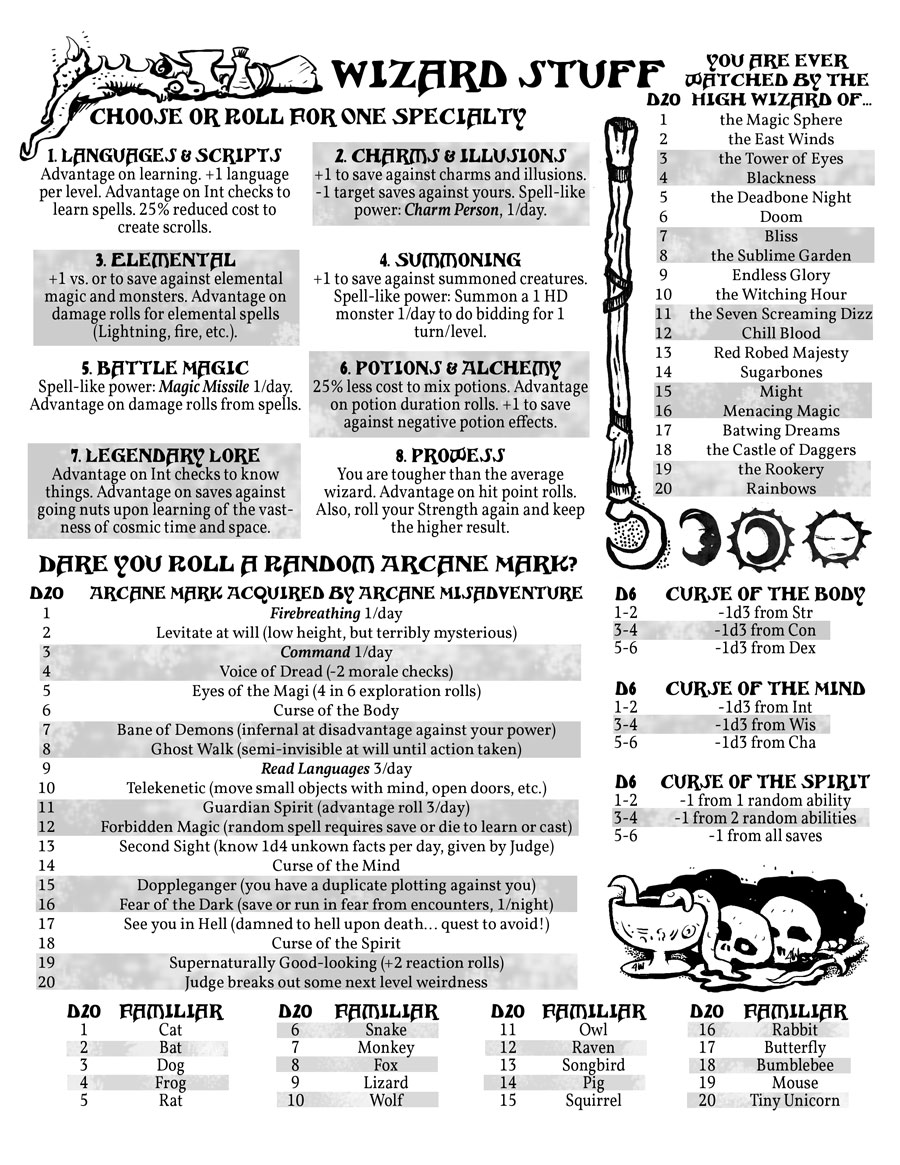
I put together a bunch of reference sheets for my own OSR house rules. These rules are generally based on old D&D such as the 1981 version by Moldvay, Cook, and Marsh (B/X). But also on Swords & Wizardry White Box. This is incomplete, but since I am pausing this project for a bit I figured I'd share the whole current series for those who might be interested. Roll some dice!




Saturday, September 23, 2017
Yria OSR Reference Sheets: Basic Stuff
I started putting together my favored OSR style rules, arranging them into sheets I can print and put into a ring binder for use at the table. The goal is to have a single binder with all the stuff I need to run games the way I like to run games. A lot of these sheets double as player handouts, so the players get a huge benefit as well. For example, you can just have a copy of the Fighter class if that's what you are playing. And so forth.
The project is currently called Yria Fantasy Campaign, named for the setting in which I place most of my OSR-style games. That could change. I favored Doomslakers OSR as the title, but people keep calling it Doom-SLACKERS... it's not "slackers". It's Doom-SLAKERS... as in "to slake the doom". *sigh* I always hated the slacker movement, so there's a negative vibe for me.
Anyway... back on point.

Yria is, of course, based on classic D&D via the various retroclones that emulate that game. Specifically, I'm using Swords & Wizardry White Box as the skeleton, with ample meat from B/X (Labyrinth Lord). I'm using ascending AC, so un-clench all you to-hit-table-haters.
The first sheet is pictured here. It's the very basic, common tools a Judge uses at the table. Stuff like reaction rolls and surprise, resting, healing, and opening doors.
I thought about going with a universal d6 system for all of that stuff, or going with ability checks like The Black Hack does. But in the end I decided this was such a small, simple list of tools that I could keep a ton of the original flavor without complicating or confusing the matter. It's really not that hard to remember when to roll a d6 and when to roll a d20.
Next up, a look at character creation. Also, all of this is subject to extreme change. And yes I do plan to compile the whole affair into some sort of book in the end.
The project is currently called Yria Fantasy Campaign, named for the setting in which I place most of my OSR-style games. That could change. I favored Doomslakers OSR as the title, but people keep calling it Doom-SLACKERS... it's not "slackers". It's Doom-SLAKERS... as in "to slake the doom". *sigh* I always hated the slacker movement, so there's a negative vibe for me.
Anyway... back on point.

Yria is, of course, based on classic D&D via the various retroclones that emulate that game. Specifically, I'm using Swords & Wizardry White Box as the skeleton, with ample meat from B/X (Labyrinth Lord). I'm using ascending AC, so un-clench all you to-hit-table-haters.
The first sheet is pictured here. It's the very basic, common tools a Judge uses at the table. Stuff like reaction rolls and surprise, resting, healing, and opening doors.
I thought about going with a universal d6 system for all of that stuff, or going with ability checks like The Black Hack does. But in the end I decided this was such a small, simple list of tools that I could keep a ton of the original flavor without complicating or confusing the matter. It's really not that hard to remember when to roll a d6 and when to roll a d20.
Next up, a look at character creation. Also, all of this is subject to extreme change. And yes I do plan to compile the whole affair into some sort of book in the end.
Wednesday, August 23, 2017

Monday, August 21, 2017
Dead Wizards: Playtest #3 in Session

A
few years ago I started thinking about a sword & sorcery game and
I called it Dead Wizards. It began as an OSR idea, specifically a
Swords & Wizardry setting/variant. My idea was to get down and
dirty with the idea of heroic fantasy as it existed in my own mind.
It had a few elements:
-Characters
are larger-than-life heroes.
-"Heroes"
means characters that rise above the world in which they live.
-Magic
is weird, not scientific.
-The
only rule of magic is that magic is never free.
-The
gods are not benevolent and life is not fair.
I
ran a session wherein I had some S&W houserules in play, such as
spending hit points to cast spells. It worked ok. But it wasn't what
I really wanted.
Another
playtest happened a few months ago but was interrupted by life stuff.
So now I've revised the rules again, stripping away even more of the
OD&D elements and leaving only the bits that I felt were
necessary to convey the point.
This
is a game about telling a yarn. The players create characters with
needs and deeds and special traits that make them larger-than-life...
like any good sword and sorcery hero. The yarn is the events in-game
that lead to the fulfillment of the various quests that the PCs have.
Their needs must be satisfied, or they must somehow fail to satisfy
them. In other words, the play creates a story.
Now,
this is not necessarily a good story. Good stories are told by
authors speaking from a top down voice whereas most RPGs, including
this one, produce "stories" that are bottom up, albeit with
some top down pressure from the GM. A Dead Wizards yarn is not meant
to be a publishable, compelling tale. it is simply the story that
emerges from play - for better or worse.
In
that sense, this game occupies a gray area between a classic RPG and
a story-based RPG.
Tonight
is session two of the playtest. The needs of the heroes should begin
to be invoked and the links between their quests should start to be
hinted at or revealed. That is the secret to Dead Wizards. Though
each player may create disparate characters, the play and the cunning
of the Judge and the players working together will weave the
characters together in a fantastic yarn.
At
least that's the plan.
For
more on Dead Wizards, particularly the system, check out this post.
Subscribe to:
Posts (Atom)