I've been using brush pens of one sort or another since the early 2000s, which is when I discovered they existed. I found them at an art store in Savannah, Georgia. It was the Faber Castell PITT, and I was in love.
I've spoken and posted about brush pens many times over the years. They are by far my favorite type of art tool. I love how they flow, how the lines can drift from thick to thin, how you don't have to stop and reink them.
In this post, I want to offer my thoughts about specific pens, how I use them, and which I prefer. If you like art tool talk, this might be interesting to you. If you are interested in brush pens but haven't dived into them or you are concerned about wasting time and money, maybe you'll find some use herein.
The thoughts expressed here are what I know from experience. I didn't do any research for this post other than looking up the names of my tools for clarity in case you want to go and get them yourself.
I apologize for the poor photos. My phone has a pretty terrible camera because I didn't want to pay hundreds more for a better one.
DEFINITIONS AND BRANDS
A brush pen is exactly what you think it is. It's a pen that has a brush tip instead of a nib, ball point, or some other traditional pen tip. Instead of dipping the brush into an ink bottle, the ink flows down by gravity from inside the pen body.
There are two main categories of brush pens. One is a "true" brush with fibers or hairs like any other brush. The other is a flexible felt tip shaped like a brush.
Brush pens have various pros and cons.
Pros:
• No dipping
• No clean up
• Tip is always ready to go
• Consistent
• Portable
Cons:
• Less flow
• Smaller tips
The flow issue might annoy you if you're used to using traditional dip brushes. The trad brush holds a lot of ink at once and that ink flows out quickly. But you have to dip it frequently, right? The brush pen holds more ink, but it's mostly all in the barrel and has to flow down by gravity. This means you'll run into dry brush if you ink very quickly. Some brushes have a more wet flow than others. None of this has been a problem for me, personally.
Here's a list of the felt tip brush pens I've used enough to be able to speak about them.
Faber Castell PITT Artist Brush Pen (felt tip)
Sakura Pigma Micron Brush Pen (felt tip)
Copic Multiliner SP Brush Pen (felt tip)
Tombow Fudenosuke Brush Pen (felt tip)
Tombow ABT Dual Tip Brush Pen (felt tip)
Kuretake Bimoji Fude (felt tip)
Here are the traditional brush tip pens I'm familiar with.
Yongsheng 3009 Brush Pen
Kuretake No. 50 Fountain Brush Pen
Pentel Fine Tip Fude Brush Pen
Sailor Profit Brush Pen
Pentel Pocket Brush Pen
FELT TIPS
Felt tips are cheaper and are usually intended to be disposable. The Copic Multiliner uses cartridges and has replacement tips you can buy, so you're reusing the body potentially forever.
But the secret is all of these cheap brush pens can be refilled. You can find YouTube tutorials on how to do it with any given brand. Generally you'll need to find an ink you like (I love Sailor Kiwaguro Ultra Black Pigmented Ink 13-2002-220) and get yourself a blunt syringe. Typically you'll just pry off the back end of the pen and squirt a little ink down into the body. But each is a bit different.
 |
| Secret of the PITT: Pull out the worn tip, flip it over... NEW TIP. |
Worst problem with the felt tips is they wear out very quickly. PITTs are really great but the tips wear down fast. I don't like Micron brushes. They always seem to be wispy and weak. But the undisputed ruler of the felt tips is the Tombow Fudenosuke! These are fantastic. Very cheap. And they come in two tips: hard and soft. Ultimate control, great durability. And very easy to squirt ink into the sponge inside the barrel to refill.
I inked Hellion Cross issue one using Fudenosukes as my main tool.
In my opinion, the Microns and Tombow ABTs are best avoided. They just aren't very good. You can use the ABT to do big area fills, though. They are cheap.
 |
| Copic tip does not hold up, in my experience. |
Copic is a well known brand and their Multiliner brush is fine. But I don't love it. It's not as good as the PITT, but close. I think Copic is more expensive to use but honestly the tips just wear out so fast.
Kuretake Bimoji pens are cool. They come in a variety of tips so you just have to try them all. I am not in love with them. I haven't tried refilling any so I don't know how easy it is.
► Try the Tombow Fudenosuke. It's damn good. I'll rate it 4.5 stars while the PITT gets 4 stars. The only thing holding it back from 5 stars is that you can't really do large black areas with it very easily. And honestly there are other pens for that, so it's not much of a flaw. The thing is just damn near perfect if you like tight control. Although, honestly, it's not really a "brush" tip. This is just a firm felt tip that comes to a sharp point and is resilient. I will also say that the Fudenosuke is fairly cheap. Cheaper than PITTs and Microns, I believe.
 |
| King of the felt tip brush pens, in my humble opinion. |
 |
| Inside the Fudenosuke is a felt tube. Squirt ink into it carefully to refill. It gets messy. |
BRUSH TIPS
The pens with real hairs or fibers are more expensive and are usually intended to be refilled. These are more permanent tools. Many of them can either use a disposable ink cartridge or an ink converter (like a fountain pen uses). You want to avoid using india ink because it gums up the works. Pigmented inks are better. Anything that is designed for a fountain pen is generally ok. Or just stick with the disposable cartridges made for the pen.
These pens are wonderful. A pleasure to use.
 |
| Yongsheng 3009. Long tip, not a very fine point. Fairly cheap. |
 |
| The piston filling mechanism. |
Yongsheng 3009 Brush Pen is a Chinese pen, I believe. I got this cheap in a set of 3 for something like $17. It's a built in piston feed system. You stick the brush tip into a bottle of ink and twist the other end to suck the ink up into the body.
The tip is longer than in other pens, so it flexes very easily. It feels nice. But it is hard to get a very fine line out of it. And I found that the tip loses that precision over time. I mainly use these now as sketching pens or to do black fills. I have one of them filled with gray ink. They are useful, but not fantastic. So far no leaking, which was surprising to me since they are so cheap.
► This is a 2 star tool. If not for the tip problem, it would be a 3.
 |
| Kuretake No. 50 has a metal body, which I like. |
 |
| The disposable cartridge can be refilled. Or use a converter. |
Kuretake No. 50 is the most expensive one I own. But you don't have to buy that one. If you want to try this brand, go for the cheaper ones like a No. 8. The No. 50 has a sable tip while No. 8 has a synthetic tip. I can't tell much difference.
Kuretake has a very wet tip and will give you big, thick lines. But it's a brush, so you can get thin lines out of it too. It'll take a lot of control. I don't use this pen very much to be honest. But it is good. Just now I opened mine to test the tip because I haven't used it in a few months. Tip is wet, soft, and ready. That means these pens are well-designed so they don't dry out easily.
► This is a 3 star tool that should be a 5.
 |
| Pop that black cap off the body and squirt ink into it to refill. |
Pentel Fine Tip Fude Brush Pen (aka Pentel Color Brush Pen) is a long plastic pen with a thick body you can squeeze. That's how you get ink to flow... you squeeze it. It has a long, flexible tip that comes to a very fine point. This one is actually really damn good for fine point drawing. I think out of all of them, this one gives you the finest possible tip.
One drawback to these is the flow. The flow is not great. You gotta squeeze it to get the ink going again. But if you like dry brush effects, these are kinda awesome. Just has an inconsistent flow.
These are not meant to be refilled. But just pop off the end of the body (where it connects to the tip, not the butt end) and you can squirt ink into it. I've done it many times.
► This is a 3.5 star tool. It would easily be 4 if not for the flow.
 |
| I am in love with Sailor Profit brush pens. But they break my heart. |
 |
| A worn tip vs. a new one. |
 |
| Again, the plastic cartridges can be refilled. |
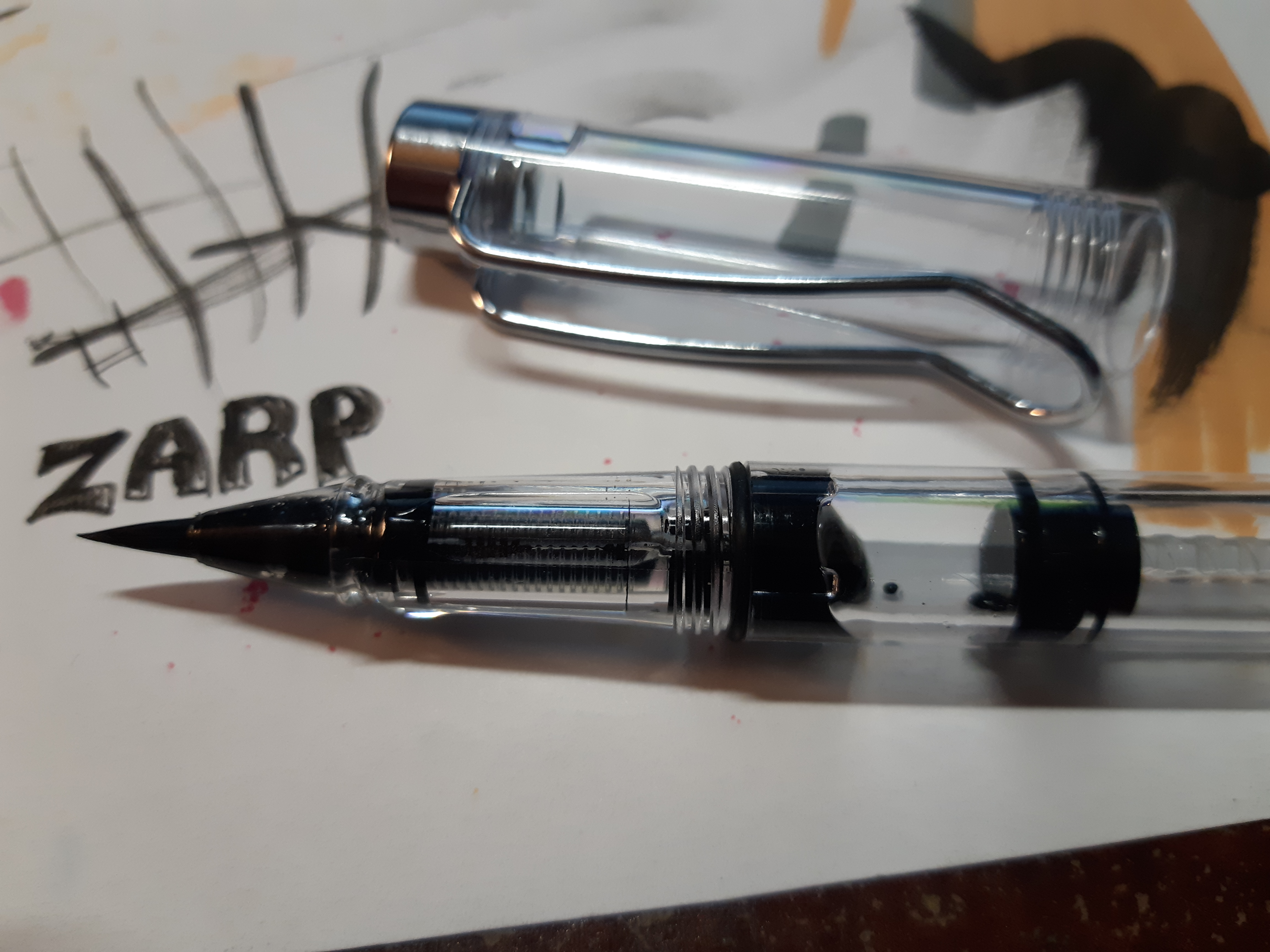
Sailor Profit Brush Pen is a real heartbreaker for me. I got one of these way back in the early 2000s but really did not use it much. I broke it out again in 2022 and started to wear it out. I actually bought a replacement tip and a whole other pen because I really love how these feel. The body style, which is like a classic cigar shaped pen, is fantastic. They are well-designed. They take a disposable cartridge or a special ink convert. But I just keep adding ink back to the used cartridge shells over and over and over.
Why is it a heartbreaker? Because of the tips. They are fat, which I like. But in my experience they do not hold a fine line. They fray over time. But they are really fantastic for doing black fills or if you want to draw with a thicker line. I use one for almost all the black fills I do.
► This is a 3.5 star tool. If you just use it for fills, I'd give it 4.5.
 |
| Pentel Pocket Brush Pen is irritatingly perfect. |
 |
| Plastic cartridge is easy to refill. |
Pentel Pocket Brush Pen is probably the king of them all. It's a slim plastic body with a snap on cap. I tend to think if it feels light then it's cheap. But don't let it fool you. This pen is fabulous. It has a durable tip that holds its shape over time. It comes to a fine point. It's flexible enough to give you fat lines.
It uses its own proprietary disposable cartridges. Of course, I constantly refill mine. A drawback is that this pen doesn't take an ink converter. But never fear... there are tutorials showing you how to hack it. You have to modify the converter so it will fit into the barrel. I haven't done this because refilling the empty cartridge is just a whole lot easier.
► This one... this is a 5 star tool. It is the best I've seen so far.
 |
| Pentel Pocket Brush on top, Sailor Profit on bottom. You can see the different bodies. |
OTHERS
I do have a couple of other brush pens I picked up to try out and I just haven't tried them yet. You don't want to ink up a pen until you're ready to use it and frankly I have so many lying around I am hesitant to ink up any more. But I'll try them out soon and report on them. They are mostly random weird cheap brush pens.
 |
| Cheap water brushes are worth playing around with. |
I picked up some very cheap water brushes at a dollar store. I can't tell you the brand because it was a few years back. These are super cheap little tools. You unscrew the ends and you can fill them with water. Then you dip into your watercolor and you have an auto-feed system for watercoloring.
I believe you could use these with thin ink like any other brush pen. But they are not high quality... I figure they will not last much use. So far, I've only used them here and there to do some watercolor work for fun. Not my usual thing.
.jpg) |
| Sailor Kiwaguro is my ink of choice. I love this stuff. |
 |
| Noodlers Black is quite good. Very different from the Sailor, though. |
.jpg) |
| Rohrer & Klingner sketch ink Thea (gray). |
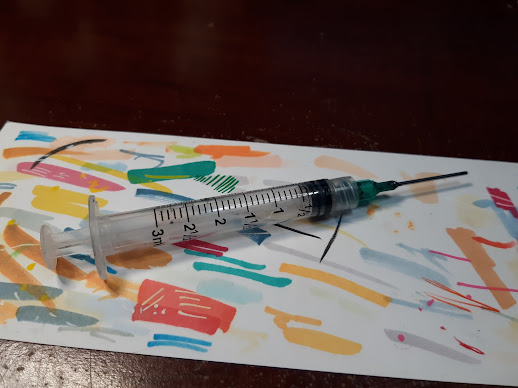 |
| Blunt syringe for squirting ink into things. Be careful. Very messy if you go hard. |
 |
| Platinum Gold ink converter, which is mostly used in fountain pens but works in many brush pens too. |

.jpg)




.jpg)

.jpg)


